
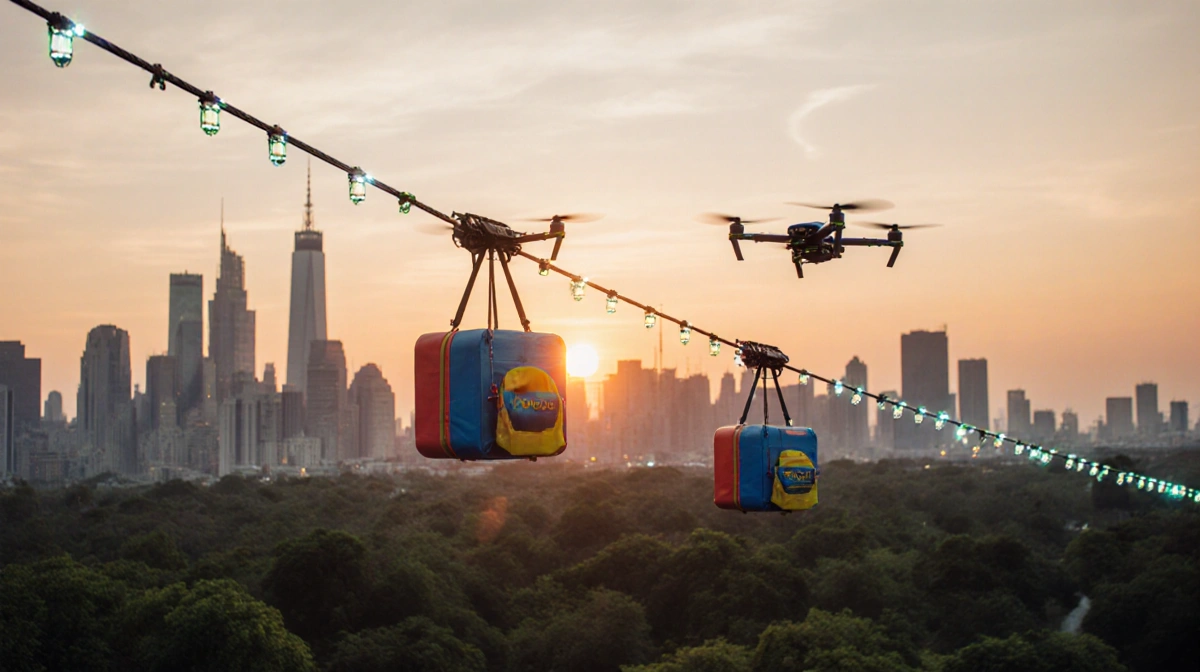

Zipline will launch drone delivery operations in Houston and Phoenix early this year after raising $600 million in fresh funding that values the company at $7.6 billion, the company said Wednesday.
The capital will bankroll expansion into at least four U.S. states by 2026 as Zipline races to make autonomous logistics a mainstream option for consumers and businesses.
At a Glance
- Zipline raised $600 million and is now valued at $7.6 billion.
- Houston and Phoenix will be the first new U.S. markets in 2025, with more cities to follow.
- The company has completed more than 2 million drone deliveries globally and is growing U.S. volume about 15% week over week.
- Why it matters: Rapid, low-cost, zero-emission deliveries could shift shopping habits away from traditional ground transport in multiple states within the next 12 months.
Founded in 2014, Zipline built its own aircraft, launch and landing hardware, and logistics software. Commercial service began in 2016 when the company used autonomous drones to deliver blood in Rwanda. The fleet now shuttles food, retail, agriculture, and health products across five African countries, several U.S. cities, and Japan.
Platform Differences
The company operates two drone systems:
- Platform 2 (P2) – designed for home delivery, carries up to eight pounds and flies within a 10-mile radius.
- Platform 1 (P1) – built for long-range enterprise, business, and government deliveries, covers 120 miles roundtrip.
P2 service debuted in Pea Ridge, Arkansas, and the Dallas-Fort Worth Metroplex through partnerships with Walmart and more than a dozen restaurant brands. Panera, Chipotle, Crumbl, Blaze Pizza, Wendy’s, and Little Caesars have also signed on, and Seattle operations are slated to start soon.
Growth Metrics
Zipline said it completed 1 million deliveries in 2024 and passed the 2 million mark this week. U.S. delivery volume has climbed roughly 15% each week for the past seven months, growth the company attributes to wider geographic coverage and consumer appetite for faster fulfillment.
Several existing and new investors joined the funding round, including Fidelity Management & Research Company, Baillie Gifford, Valor Equity Partners, and Tiger Global. The influx brings total valuation to $7.6 billion and will underwrite fleet expansion, new distribution centers, and additional regulatory approvals needed for multi-state service.
Co-founder and CEO Keller Cliffton called 2026 the company’s breakout year.
“Autonomous logistics has been maturing for more than a decade, and the last year has made it unmistakably clear that when deliveries are faster, cleaner, safer, and cheaper, demand isn’t just high, it grows exponentially,” Cliffton said. “In 2026 autonomous logistics will become an everyday staple for people across several states in the U.S. That transformation starts with Houston and my home town of Phoenix, which we’ll begin serving early this year, and then expand to even more places across the country throughout the year.”
Competitive Landscape
Drone delivery is crowded. Rivals include Flytrex, DroneUp, Amazon Prime Air, and Wing, the Alphabet-owned service that also works with Walmart. Wing has announced plans to reach another 150 Walmart locations by 2027, setting up a direct race for suburban airspace and quick-commerce customers.
Zipline enters 2025 with fresh capital, accelerating U.S. demand, and a dual-platform model that targets both consumer doorsteps and enterprise supply chains. If the company maintains its current weekly growth rate, it could scale into millions of additional deliveries before the next funding cycle, positioning autonomous logistics as a common convenience rather than a tech curiosity.
Key Takeaways
- $600 million in new funding fuels Zipline’s U.S. expansion.
- Houston and Phoenix mark the first of several planned domestic markets for 2025.
- Over 2 million deliveries completed, with U.S. volume rising 15% weekly.
- Competition intensifies as Wing, Amazon, and others scale drone networks.