
At a Glance
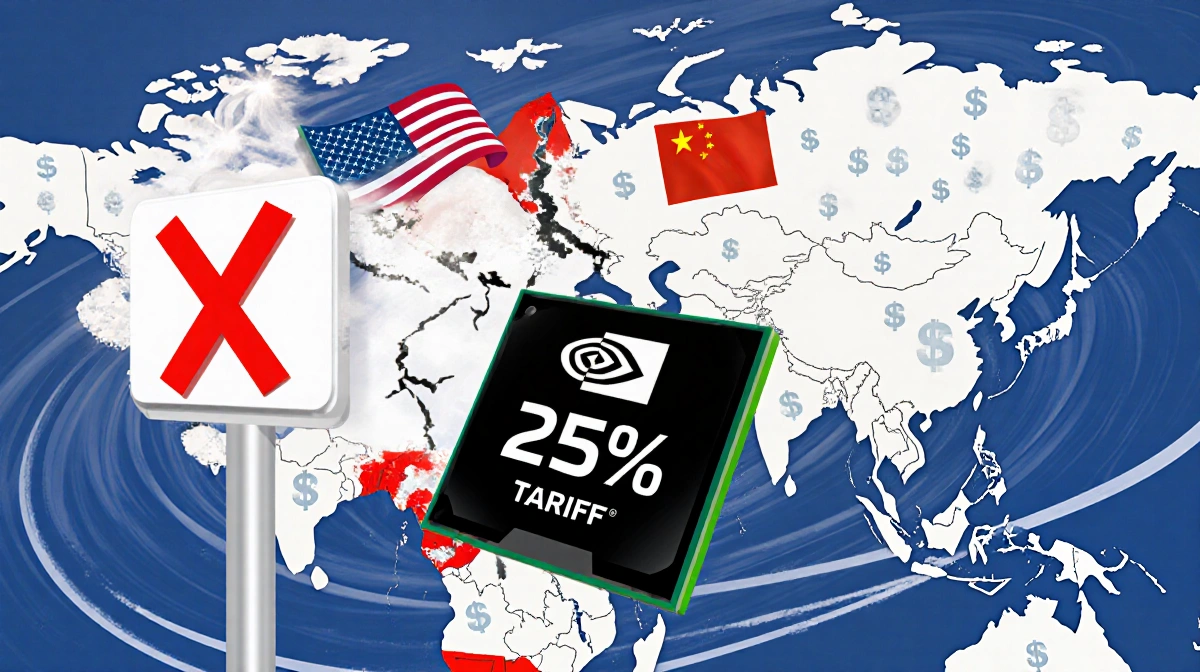
- President Trump signed a 25% tariff on advanced AI semiconductors passing through the U.S. to China
- Nvidia’s H200 and AMD’s MI325X are the primary chips affected
- Commerce Department simultaneously cleared Nvidia to sell H200 to vetted Chinese buyers
- Only 10% of chips used in America are made domestically, per White House proclamation
- Why it matters: Move aims to protect U.S. supply chains while letting American firms profit from Chinese demand
President Donald Trump on Wednesday formalized a 25% tariff on certain high-end AI chips that are built abroad, routed through the United States, and then exported to China. The executive order targets Nvidia’s forthcoming H200 accelerators and AMD’s MI325X, both prized for training large-scale artificial-intelligence models.
The announcement ends months of speculation that the administration would impose semiconductor levies. It also clarifies how Nvidia can proceed after receiving Commerce Department approval in December to supply H200 units to approved Chinese customers.
H200 Wins U.S. Sales Green Light Despite Tariff
Although the tariff adds cost, Nvidia publicly praised the decision.
“We applaud President Trump’s decision to allow America’s chip industry to compete to support high-paying jobs and manufacturing in America. Offering H200 to approved commercial customers, vetted by the Department of Commerce, strikes a thoughtful balance that is great for America,” an Nvidia spokesperson emailed News Of Philadelphia.
The tariff does not apply to chips imported for U.S. research, defense, or commercial use inside the country. It only hits merchandise that lands in American ports temporarily before continuing to foreign buyers.
Chinese firms have already shown strong appetite for the H200. Jordan M. Lewis reported that Nvidia weighed boosting production after early orders surged from Chinese data-center operators and cloud providers.
Beijing Weighs Own Limits on Purchases
China now faces a balancing act. The central government is drafting rules that would cap how many overseas semiconductors domestic companies can buy, according to Nikkei Asia. If adopted, the quotas would reverse Beijing’s recent hostility to imported AI silicon and allow controlled purchases of Nvidia hardware while Beijing tries to nurture home-grown alternatives.
U.S. officials frame the tariff as a step toward reducing American dependence on foreign fabs. Wednesday’s proclamation notes the United States currently manufactures only about 10% of the chips it consumes, calling that reliance “a significant economic and national security risk.”
Tariff Mechanics and Market Impact
- Rate: 25% on covered semiconductors
- Scope: Chips produced outside the U.S., transiting U.S. territory, then exported to China
- Covered products: Nvidia H200, AMD MI325X, and other advanced AI accelerators
- Exemptions: Chips staying in the U.S. for research, defense, or commercial deployment
The order gives Customs and Border Protection authority to collect the duty when the merchandise is re-exported. Importers must document the final destination and prove the chips meet performance thresholds set by Commerce.
For Nvidia, the tariff is a cost it can likely pass along. Chinese cloud giants have few alternatives matching the H200’s memory bandwidth and energy efficiency, giving the chipmaker pricing power even after the levy.
Broader Chip Policy Context
Washington’s move fits a wider campaign to secure semiconductor supply chains. Congress in 2022 approved $52 billion in subsidies to spur U.S. fabrication plants, yet only a handful of leading-edge facilities are under construction. Wednesday’s action complements those incentives by discouraging offshore production aimed at the Chinese market.
Beijing, meanwhile, has poured an estimated $100 billion into domestic chip projects since 2014, culminating in breakthroughs such as Huawei’s Ascend AI accelerators. Still, Chinese fabs trail Taiwan’s TSMC and South Korea’s Samsung by at least two process generations, leaving firms dependent on foreign technology for cutting-edge workloads.
Key Takeaways
- The 25% tariff adds friction to U.S.-China AI chip trade but does not ban sales outright
- Nvidia secured simultaneous approval to supply H200 to vetted Chinese buyers, softening the blow
- China may respond with purchase quotas rather than blanket bans, preserving access to U.S. silicon
- Domestic U.S. chip making remains a small fraction of total demand, keeping foreign supply chains critical