
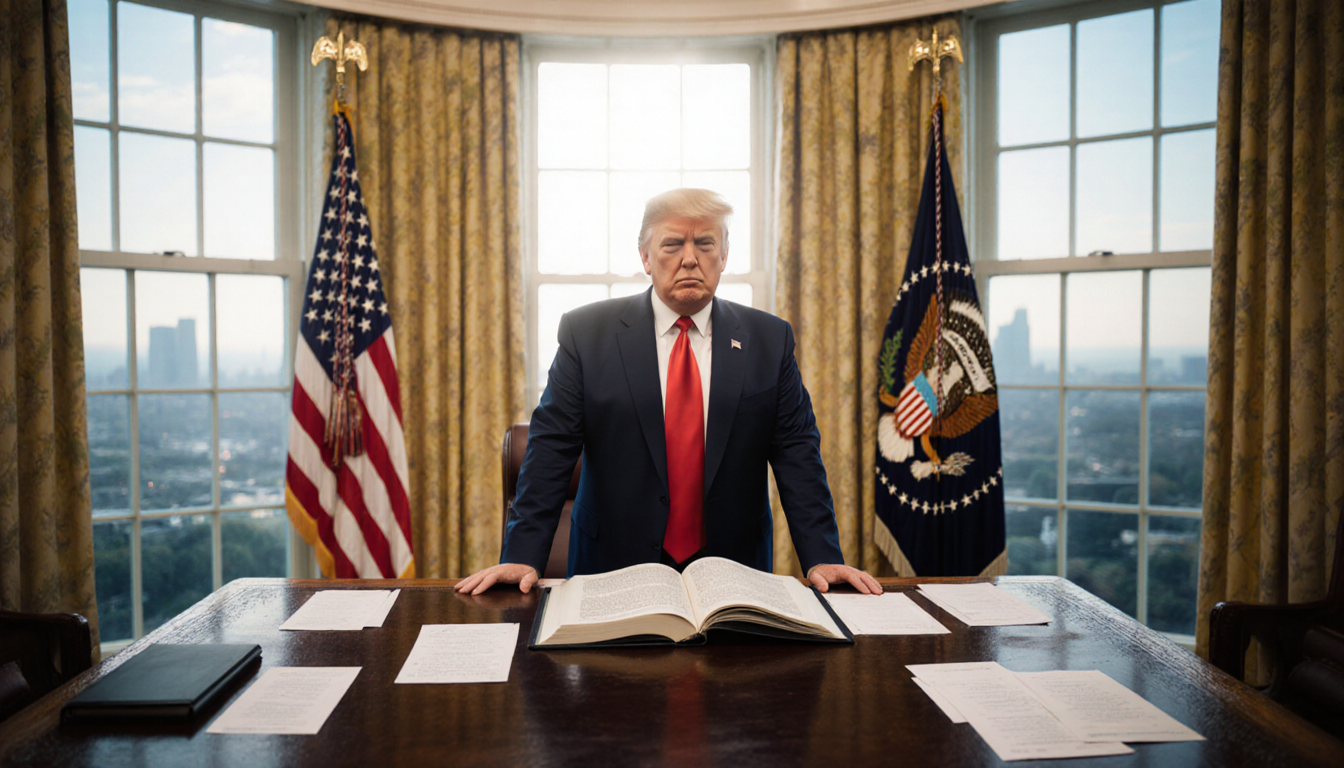


President Donald Trump signed an executive order Thursday evening that seeks to limit the ability of states to regulate artificial intelligence while attempting to thwart some existing state laws. The order, posted on the White House website, states its purpose is “to sustain and enhance the United States’ global AI dominance through a minimally burdensome national policy framework for AI.”
A Single Rulebook for AI
At the Oval Office signing ceremony, Trump explained why he believes a federal standard is necessary. “AI companies want to be in the United States, and they want to do it here, and we have big investment coming. But if they had to get 50 different approvals from 50 different states, you could forget it,” he said. In a Truth Social post on Monday, he added, “There must be only One Rulebook if we are going to continue to lead in AI. That won’t last long if we are going to have 50 States, many of them bad actors, involved in RULES and the APPROVAL PROCESS.”
The executive order directs several officials to take specific actions. Attorney General Pam Bondi must create an ”AI Litigation Task Force” within 30 days. The task force’s sole responsibility is to challenge state AI laws that clash with the administration’s vision for light‑touch regulation. Commerce Secretary Howard Lutnick is instructed to identify state laws that ”require AI models to alter their truthful outputs,” a reference to the administration’s earlier efforts to curb what it calls ”woke AI.” States found to have such ”onerous” laws may have to agree not to enforce those statutes in order to receive discretionary federal funding.
White House AI czar David Sacks and director of the Office of Science and Technology Policy Michael Kratsios are asked to draft recommendations for a federal law that would preempt, or supersede, state laws regulating AI. The order clarifies that the recommendations will not affect state AI laws related to child safety protections, data center infrastructure, state procurement of AI, or other topics that have not yet been established.
Congressional History and Political Context
The executive order follows a series of failed congressional attempts to create a nationwide AI framework. In late November, House Republicans tried to insert a provision into the National Defense Authorization Act that would give the federal government exclusive authority over AI legislation. The language was removed after backlash. Earlier in July, a similar effort stalled. Critics say the order is an attempt to block meaningful regulation on AI and to rely on the executive branch instead of Congress to replace existing state laws with a national standard.
Brad Carson, director of the bipartisan AI advocacy group Americans for Responsible Innovation and a former member of Congress, called the order ”another attempt to push through unpopular and unwise policy.” Carson told NBC News on Wednesday, ”Big Tech has failed twice to jam an AI amnesty into legislation.” He added that the executive order ”will soon be blocked in court.”
Statements from Supporters and Opponents
At the signing ceremony, supporters highlighted the order’s importance for maintaining America’s AI advantage over China. Senator Ted Cruz, R‑Texas, said, ”It’s a race, and if China wins the race, whoever wins, the values of that country will affect all of AI.” He continued, ”We don’t want China’s values of surveillance and centralized control by the communist government governing AI.” ”We want American values of free speech, of individual liberty, of respecting the individual. So this executive order, I believe, is tremendously important,” Cruz added.
Steve Bannon, on the Wednesday broadcast of his ”War Room” podcast, criticized the lack of controls on frontier labs. ”It doesn’t make sense if we’re having a Sputnik moment and we can’t have any controls over the frontier labs,” he said. ”You have more regulations about launching a nail salon on Capitol Hill than you have on the frontier labs. We have no earthly idea what they’re doing.”
Senator Ed Markey, D‑Mass., released a statement calling the executive order ”an early Christmas present for his CEO billionaire buddies.” Markey described the order as ”irresponsible, shortsighted, and an assault on states’ ability to safeguard their constituents.”
The Broader Debate
Regulation surrounding AI is emerging as a hot‑button political topic. Concerns range from pollution, soaring electricity prices, and noise from data centers to the potential for AI chatbots to exacerbate teens’ mental health struggles. Across the political spectrum, many Americans are beginning to call for effective AI laws.
Mackenzie Arnold, director of U.S. policy at the Institute for Law and AI, cautioned that the administration’s reasoning should be contextualized. ”By that same logic, states wouldn’t be allowed to pass product safety laws — almost all of which affect companies out of state that sell their goods nationally. But those laws are the classic example of acceptable state legislation,” Arnold said.
Key Takeaways
- The executive order seeks to limit state regulation of AI and create a federal standard.
- It directs officials to challenge existing state laws and draft a federal preemption law.
- The order follows failed congressional attempts and faces criticism from both sides of the aisle.
The executive order represents a significant shift in how the United States may approach AI regulation, concentrating authority in the federal government while drawing sharp partisan responses.