
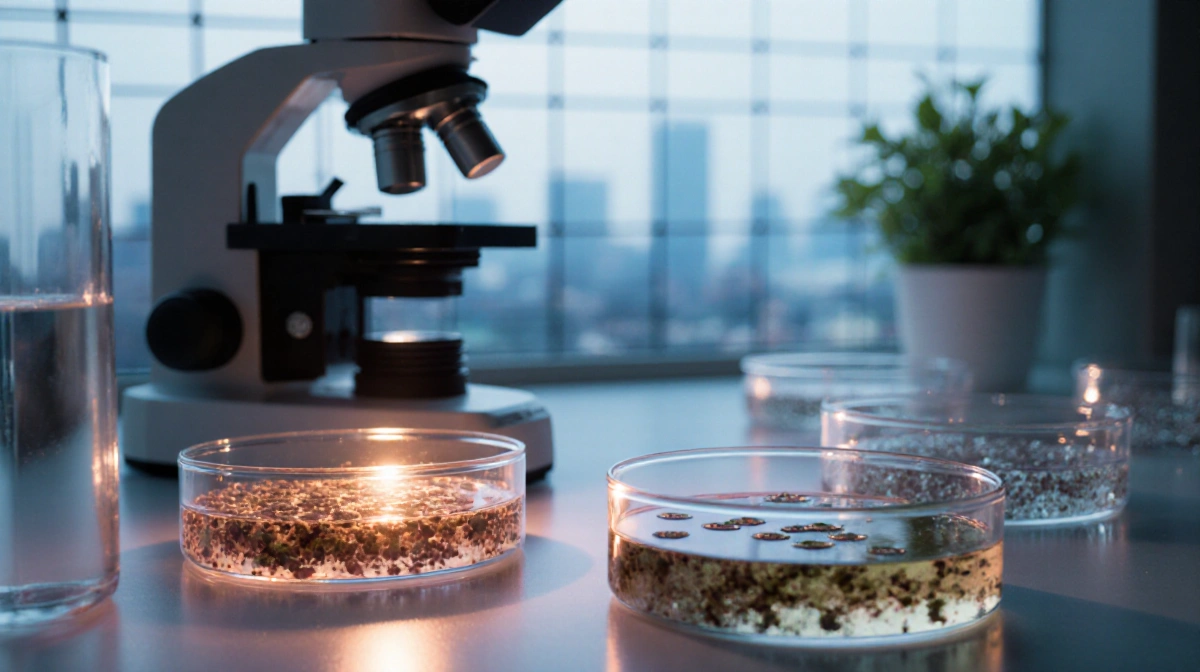

A breakthrough in microbial technology could help avert a looming copper shortage that threatens to derail the global energy transition.
At a Glance
- Transition Metal Solutions says its additives raise copper yields by 20-30%
- Lab tests lifted extraction to 90% vs. 60% with standard methods
- Seed round of $6 million led by Transition Ventures
- Why it matters: Copper demand may outstrip supply by 25% by 2040
The world could face a severe copper shortfall as early as 2040, with demand projected to exceed supply by 25%. Everything from data centers to electric vehicles depends on the metal, and prices are already climbing as investors pour money into new projects. AI minerals startup KoBold, for example, raised $537 million last year to develop a Zambian deposit.
Rather than digging new holes, Transition Metal Solutions wants miners to squeeze more metal out of existing rock. The company applies low-cost, mostly inorganic compounds-already present on site-to nurture entire microbial communities that leach copper from ore.
Microbes as Supporting Cast, Not Solo Stars
Traditional biotech efforts have tried to isolate or engineer a few high-performing strains and flood heaps with them. Co-founder and CEO Sasha Milshteyn told News Of Philadelphia that approach rarely sustains gains.
“Often they will see kind of a boost early on and then it just kind of falls off-or they don’t see any boost at all,” he said.
Milshteyn believes the flaw is ignoring microbial teamwork. More than 90% of organisms in a heap leach are unknown to science, and mimicking the acidic, metal-laden environment in a lab is difficult. Standard molecular tools falter at pH levels around two, where clays and competing metals complicate analysis.
“Everything that the industry has done has really focused on that tiny fraction that people have been able to grow in the lab,” he said. “Typically, it’s in the 5% range that you can culture.”
Transition’s strategy is to shift the whole community toward higher function. Its proprietary cocktail nudges native microbes rather than importing foreign strains. In controlled tests, the additives lifted copper recovery to 90%, compared with 60% using conventional chemistry.
Field Expectations and Tailored Recipes
Real-world heaps won’t reach lab levels, but Milshteyn expects meaningful gains. Most operations recover 30-60% of copper; he aims to push that range to 50-70%, and possibly higher as formulas improve.
Each mine hosts a unique microbial mix, so Transition will customize additives after on-site sampling. Over time, data should enable upfront predictions of what a given deposit needs.
“We’re leaving 65% of material behind” at typical mines, Milshteyn said. “We may as well get as much out of it as we can.”
Proving It to a Skeptical Industry
Before miners rewrite flow-sheets, they want third-party proof. Transition will fund metallurgical validation at an independent lab recognized across the industry. “Without third party results, nobody’s going to believe you,” Milshteyn said.
The $6 million seed round, led by Transition Ventures and joined by Astor Management AG, Climate Capital, Dolby Family Ventures, Essential Capital, Juniper VC, Kayak Ventures, New Climate Ventures, Possible Ventures, SOSV and Understorey Ventures, will cover that verification step.
Following successful lab confirmation, Transition plans to treat a demonstration heap of tens of thousands of tons. If results hold, the company will pursue global deployments.
Success could ease long-term supply anxiety. A 20-30% production bump from existing operations would narrow the projected 25% supply gap and reduce pressure to open environmentally sensitive greenfield mines.
Key Takeaways
- Copper demand may exceed supply by 25% within two decades
- Transition’s prebiotic additives target entire microbial communities, not single strains
- Third-party metallurgical testing is the next gate before commercial rollout
- Even modest field gains could keep millions of tons of copper out of waste piles