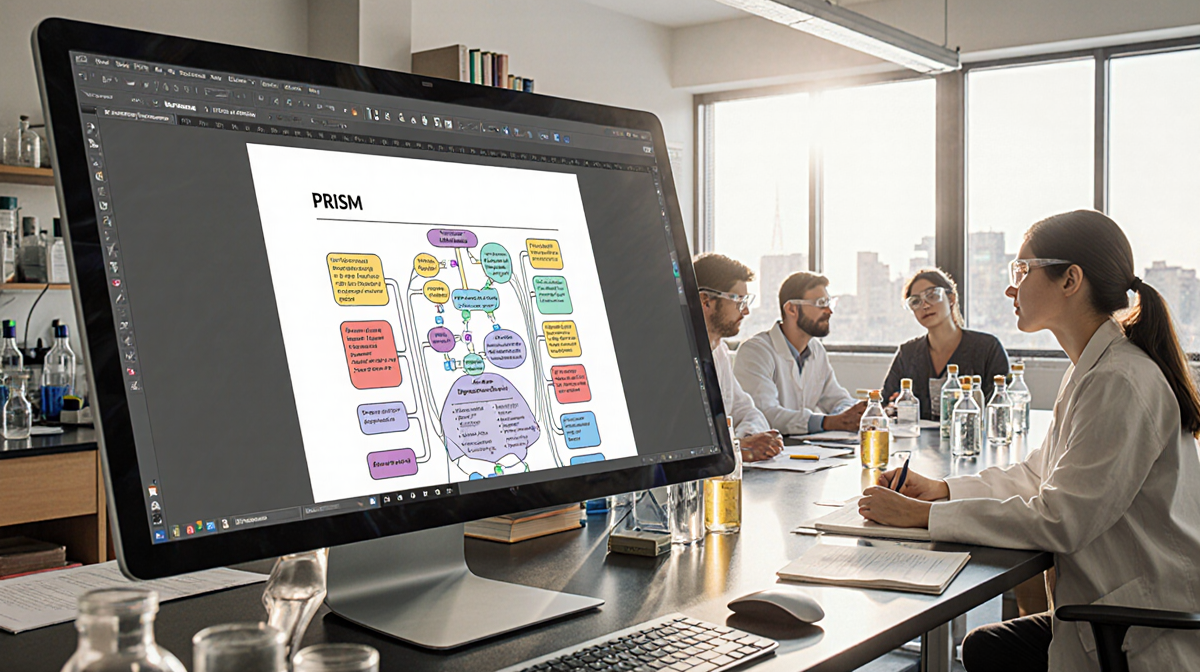

At a Glance
- Prism is a free AI-enhanced word processor for scientific papers, powered by GPT-5.2.
- OpenAI reports an average of 8.4 million weekly messages on advanced science topics in ChatGPT.
- The tool integrates with LaTeX and visual diagram creation, aiming to speed research workflows.
- Why it matters: Scientists can now collaborate with AI in drafting, proof-checking, and diagramming without leaving a single platform.
OpenAI announced the launch of Prism on Tuesday, offering a free, web-based scientific workspace for anyone with a ChatGPT account. The tool, described as an AI-enhanced word processor and research assistant, is tightly coupled with GPT-5.2 to evaluate claims, rewrite prose, and locate prior work.
OpenAI Launches Prism, a Free AI-Enhanced Scientific Workspace
Prism is not meant to conduct research autonomously; it requires human direction. Executives liken it to coding interfaces such as Cursor and Windsurf, emphasizing that the AI augments rather than replaces the researcher.
Kevin Weill, VP of OpenAI for Science, said in a press call: “I think 2026 will be for AI and science what 2025 was for AI and software engineering.”
How Prism Works
The platform is accessed through a web app. Users open a ChatGPT window inside Prism, allowing the model to see the entire research context-references, notes, and drafts-making responses more relevant and intelligent.
Key features include:
- Deep GPT-5.2 integration for claim assessment and prose revision.
- LaTeX compatibility that goes beyond standard formatting tools.
- Visual diagram assembly using GPT-5.2’s image generation, turning whiteboard sketches into polished figures.
| Feature | Description |
|---|---|
| Context-aware AI | Full project context for smarter replies |
| LaTeX integration | Seamless typesetting and formatting |
| Diagram generation | Convert sketches into publication-ready images |
The Demand for AI in Scientific Research
OpenAI reports that ChatGPT receives an average of 8.4 million messages a week on advanced science topics. The company notes it is unclear how many of these come from professional researchers, but the volume signals growing interest.
AI-assisted research is also becoming mainstream in academia. In mathematics, AI models have helped prove several long-standing Erdős problems by combining literature review with novel techniques. While the significance of these proofs is debated, they represent early victories for AI and formal verification proponents.
A December statistics paper used GPT-5.2 Pro to establish new proofs for a central axiom of statistical theory. Human researchers only prompted and verified the model’s work. OpenAI highlighted the result in a blog post, framing it as a model for future human-AI collaboration.
The post read: “In domains with axiomatic theoretical foundations, frontier models can help explore proofs, test hypotheses, and identify connections that might otherwise take substantial human effort to uncover.”
Early Wins and Community Response
The release of Prism coincides with a surge of scientific queries to consumer AI products. By offering a dedicated workspace, OpenAI hopes to attract researchers who might otherwise avoid generic chat interfaces.
Weill explained the strategy: “Software engineering accelerated in part because of amazing models, and in part because of deep workflow integration.” He added that Prism’s clean interface could draw in scientific researchers more quickly, mirroring the success seen in software development.

Looking Ahead
OpenAI plans to refine Prism’s capabilities, potentially adding more domain-specific tools and tighter integration with research databases. The company’s current focus is on improving context management and visual outputs to reduce friction for scientists.
The launch event took place in San Francisco on Oct 13-15, 2026, highlighting the tool’s potential impact on the scientific community.
Key Takeaways
- Prism offers a free, AI-enhanced workspace that integrates GPT-5.2, LaTeX, and visual diagramming.
- OpenAI sees a high volume of scientific queries, indicating strong demand.
- Early AI-assisted research successes demonstrate the tool’s promise.
- The platform aims to streamline scientific workflows, similar to how AI tools accelerated software engineering.
—