
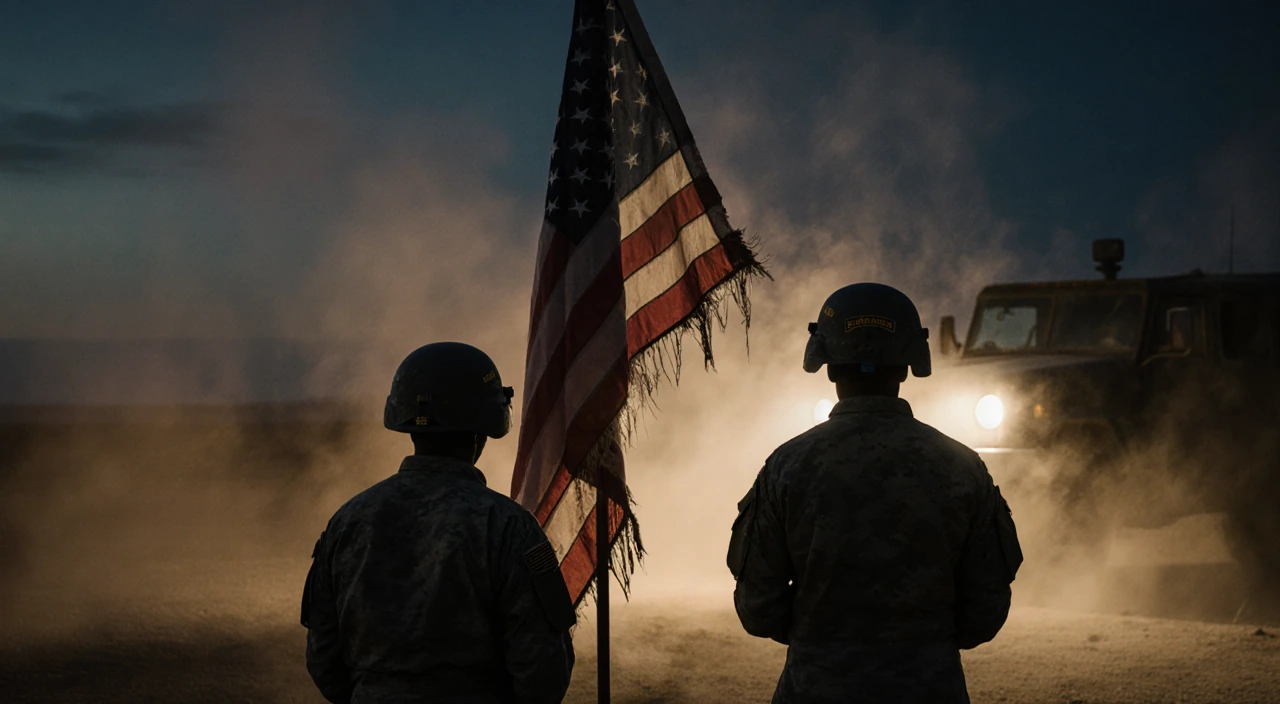
Two Iowa National Guard soldiers lost their lives in a weekend assault in Syria, a strike the U.S. military attributes to Islamic State militants.
The Attack and Casualties
The attack, which took place Saturday in the Syrian desert near the historic city of Palmyra, also wounded members of the country’s security forces, and the gunman was killed. A U.S. civilian interpreter also died, according to Pentagon spokesman Sean Parnell. Three other Guard members were wounded, with two in stable condition and the third in good condition.
Response from Iowa and National Guard
Iowa Governor Kim Reynolds ordered all flags in the state to fly at half‑staff in honor of the fallen soldiers. “We are grateful for their service and deeply mourn their loss,” Reynolds said. The Iowa National Guard remembered the soldiers as dedicated and cherished members of the Guard family. Stephen Osborn, the adjutant general, said the focus now is to provide unwavering support to their families.
Details of the Incident
The gunman, a base security guard who had joined Syria’s internal security forces two months earlier, was recently reassigned amid suspicions that he might be affiliated with IS, a Syrian official said. He stormed a meeting between U.S. and Syrian security officials who were having lunch together and opened fire after clashing with Syrian guards, Interior Ministry spokesperson Nour al‑Din al‑Baba said. Al‑Baba acknowledged it was a “major security breach” but noted that since Assad’s fall, “there have been many more successes than failures” by security forces.
U.S. Military and Presidential Reaction
The U.S. Army said Monday that the incident is under investigation. Military officials and President Donald Trump blamed the attack on an IS member. Defense Secretary Pete Hegseth posted on social media, “Our hearts go out to their families, and we lift them up in prayer for strength and comfort during this time of grief. The United States of America will avenge these fallen Americans with overwhelming force.” Trump said over the weekend that “there will be very serious retaliation” for the attack and that Syrian President Ahmad al‑Sharaa was “devastated by what happened,” stressing that Syria was fighting alongside U.S. troops. Trump welcomed al‑Sharaa, who led the lightning insurgency that toppled Assad’s rule, to the White House for a historic meeting last month.
Background on the Soldiers
Sgt. Edgar Brian Torres‑Tovar, 25, of Des Moines, and Sgt. William Nathaniel Howard, 29, of Marshalltown, had served over 11 years in the Guard. Howard had wanted to be a soldier since he was a young boy, according to Jeffrey Bunn, Howard’s stepfather and chief of the Meskwaki Nation Police Department in Tama, Iowa. Bunn wrote on the department’s Facebook page that Howard loved what he was doing, would be the first in and last out, and was a loving husband and “amazing man of faith.” Howard’s younger brother, a staff sergeant in the Iowa National Guard, would escort “Nate” back to Iowa.
Tributes and Character
Three fellow Guard members deployed with Torres‑Tovar reflected on his character in a joint statement to local TV station WOI. David Hernandez, Freddy Sarceño, and Luis Corona described him as “very positive,” family oriented and always putting others first. The soldiers were also remembered as cherished members of the Guard family, according to Osborn.
Broader Context of U.S.-Syria Cooperation
The attack was a major test for the rapprochement between the United States and Syria since the ouster of autocratic leader Bashar Assad a year ago, as the U.S. military expands its cooperation with Syrian security forces. Hundreds of American troops are deployed in eastern Syria as part of a coalition fighting IS.
Key Takeaways
- Two Iowa National Guard soldiers killed, interpreter also died, three Guard wounded.
- Flags flown half‑staff in Iowa; state honors the fallen.
- Trump vows retaliation; U.S. military investigates; attack blamed on IS.
The tragic loss of Sgt. Torres‑Tovar and Sgt. Howard underscores the risks faced by U.S. soldiers abroad and the ongoing tensions in Syria, while the response from Iowa and Washington highlights the nation’s commitment to honoring fallen service members and pursuing accountability.