
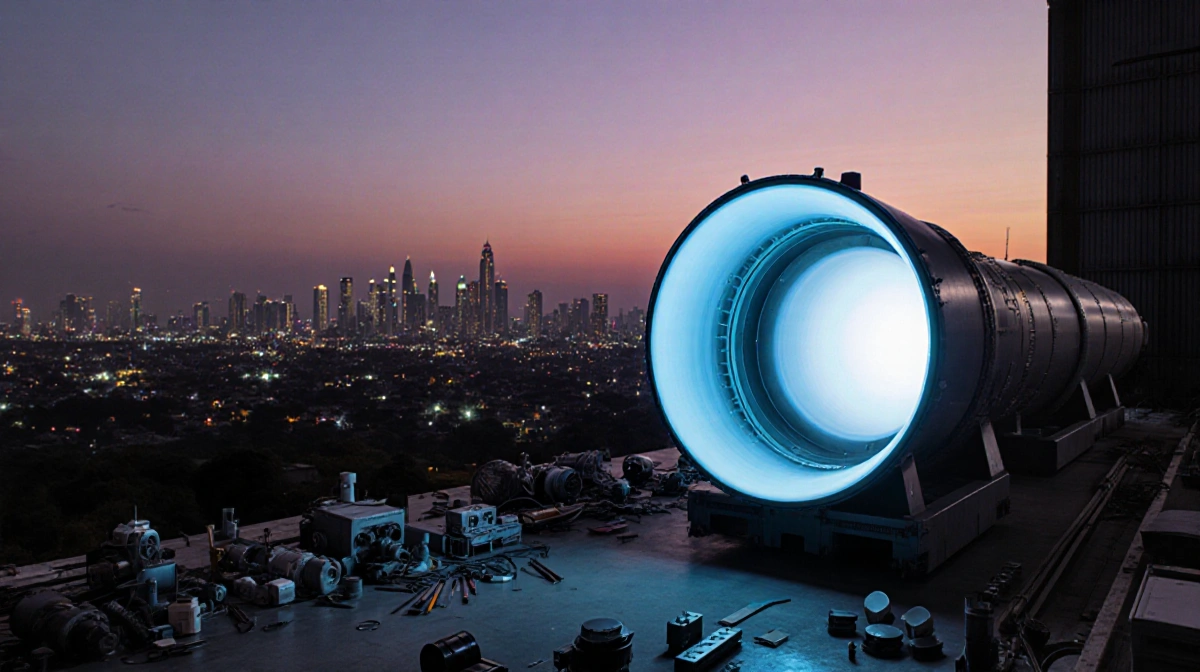

Bengaluru-based Ethereal Exploration Guild, operating as EtherealX, has quintupled its valuation to $80.5 million after securing a $20.5 million Series A round, according to News Of Philadelphia‘s earlier reporting.
At a Glance
- EtherealX closed an oversubscribed $20.5 million Series A led by TDK Ventures and BIG Capital
- The raise lifts valuation 5.5× to $80.5 million, up from $14.6 million in August 2024
- Hot-fire tests for two in-house engines are targeted for June-July 2025
- Why it matters: The startup’s fully reusable launcher could undercut SpaceX Falcon 9 pricing while offering greater schedule flexibility for satellite operators
The fresh capital follows a $5 million seed round closed just eight months ago. Accel, Prosus, YourNest, BlueHill, Campus Fund, and Riceberg Ventures joined the oversubscribed Series A.
Fully Reusable Design Aims to Undercut Falcon 9
Unlike Falcon 9, which reuses only its first-stage booster, EtherealX is engineering both booster and upper stage to return intact. The approach, if proven, promises to trim per-launch costs and boost flight frequency without relying on a proprietary satellite constellation to fill manifests.
The company is developing two engines from scratch:
- Pegasus: 80-kilonewton upper-stage engine delivering 323 seconds of vacuum-specific impulse via a proprietary “full-flow segregated cooling cycle” and an additively manufactured turbopump
- Stallion: 1.2-meganewton booster engine using a gas-generator cycle and delivering 306 seconds of sea-level specific impulse
Clustering will power the Razor Crest Mk-1 medium-lift vehicle: nine Stallion engines on the booster and 15 Pegasus engines on the upper stage.
Launch Timeline and Payload Capacity
Hot-fire tests for both engines are slated for June-July 2025. A technology demonstration flight is penciled in for November-December 2027, with commercial missions expected to begin toward the end of 2028, co-founder and CEO Manu J. Nair told News Of Philadelphia.
Payload capacity targets:
| Configuration | Lift to LEO |
|---|---|
| Expendable | 24.8 tonnes |
| Partially reusable | 22.8 tonnes |
| Fully reusable | 8 tonnes |
Pricing is projected at $350-$2,000 per kilogram, depending on configuration and launch cadence.
Infrastructure and Early Demand
EtherealX currently operates Base 001, a rocket engine test site in Tamil Nadu focused on qualifying the Pegasus upper-stage engine. A 150-acre manufacturing and testing campus in Andhra Pradesh’s proposed space city is scheduled to come online by mid-2026 for integrated engine and stage testing.
The startup has signed launch memoranda of understanding worth roughly $130 million with customers including Japan’s SpaceBD and Taiwan’s space agency TASA, securing early commercial demand ahead of its first demonstration flight.
Workforce Expansion
The company employs 67 people and plans to reach about 90 within two months as it scales manufacturing and testing ahead of the 2027 demo launch. The Series A funds will complete flight qualification of the Stallion booster engine and support clustered-firing tests of the Pegasus upper-stage engines.