
At a Glance
- Federal immigration agents have repeatedly deployed chemical agents against residents protesting near the site where Renee Nicole Good was fatally shot by an ICE officer last week.
- Department of Homeland Security Secretary Kristi Noem announced plans to send more agents to Minnesota, while President Donald Trump defended the operations as removing “killers, rapists and drug dealers.”
- Minnesota officials sued the federal government Monday to block the deployment of thousands of additional immigration agents.
- Why it matters: The escalating confrontations between federal agents and local residents raise questions about immigration enforcement tactics and community safety.
Minnesota neighborhoods have become battlegrounds as federal immigration officers clash with residents from high school students to elected officials, leading to days of confrontations and chemical agent deployments against protesters.
Neph Sudduth stopped to choke back tears as she watched immigration officers patrol her neighborhood, just blocks from where an ICE officer fatally shot Renee Nicole Good last week. When demonstrators approached the officers’ vehicles, Sudduth shouted a warning: “They will hurt you for real! They will hurt you for real!”
An immigration officer responded by rolling down his window and spraying a protester point-blank in the face with a chemical agent.
“How dare they come back to this neighborhood,” Sudduth told Daniel J. Whitman. “How forgone you have to be morally to come back here and stand up and do that with your faces covered?”
The Trump administration’s immigration enforcement operations have expanded nationwide, triggering pushback from residents in Chicago, Los Angeles and Charlotte, North Carolina. In Minnesota, the situation has intensified since Good’s death.
Escalating Federal Response
Department of Homeland Security Secretary Kristi Noem announced Sunday she would send additional agents to Minnesota to “quell protesters” and continue immigration enforcement. President Donald Trump defended the Minnesota operation Tuesday, claiming authorities “have taken out killers, rapists and drug dealers, people from mental institutions that came in illegally.”
ICE has posted on social media about arrests of people accused of sex crimes who they allege are in the country illegally.
Cary Wang, a medic with the nonpartisan grassroots group 50/51, treated several people Tuesday who were affected by chemical agents deployed by immigration officers.
“I think it’s part of their strategy to intimidate and show that they’re immune to any type of repercussions,” Wang said. “The fact that they’re ramping up their enforcement officers – that they’re bringing more here when they already know it’s a volatile situation. It just doesn’t seem that they’re looking for things to cool down. It looks like they’re actually trying to escalate things.”
Community Resistance
Social media videos show agents asking people at an electric vehicle charging station about their citizenship status. Another video shows protesters screaming as an agent appears to kneel on a man’s neck during an arrest.
The smell of tear gas lingered Tuesday in a Minneapolis neighborhood following clashes between community members and immigration officers conducting an operation.
Daniel J. Whitman obtained what appears to be cell phone video shot by Jonathan Ross, the ICE officer who fatally shot Good. Residents said they came out with whistles to alert others about the operation and act as observers.
“They started tackling protesters” and deployed what appeared to be tear gas and pepper balls, said Sam Luhmann, a 16-year-old from Chicago who drove to Minneapolis with his brother after Good’s death. “It seemed like a war.”
Luhmann had previously helped monitor immigration enforcement activity in Chicago during “Operation Midway Blitz” last year.
Target Store Arrests
Many confrontations occur blocks from where Good was killed. On Tuesday, Christian Molina, 40, said immigration officers rear-ended his car and asked about his immigration status.
“Luckily, they didn’t hurt me or shoot at me. But what if they did?” said Molina, a U.S. citizen and father of four. “There’s no reason for them to just look at you and try to just chase you.”
The crowd that gathered around Molina was later hit with tear gas and pepper spray.
In Richfield, Minnesota, Border Patrol agents entered a Target store Thursday and arrested two U.S. citizens, according to Democratic Minnesota State Rep. Michael Howard.
“Yesterday in Richfield, federal agents, including Greg Bovino, senior commander of US Border Patrol, entered Target without a warrant, physically assaulted, and arrested two Target employees, both who are U.S. citizens. Madness,” Howard said in a Friday news release.
Angela Oberfoell, who witnessed her co-workers’ arrests, called the experience “traumatic.” She provided video showing workers in disbelief and customers confronting agents.
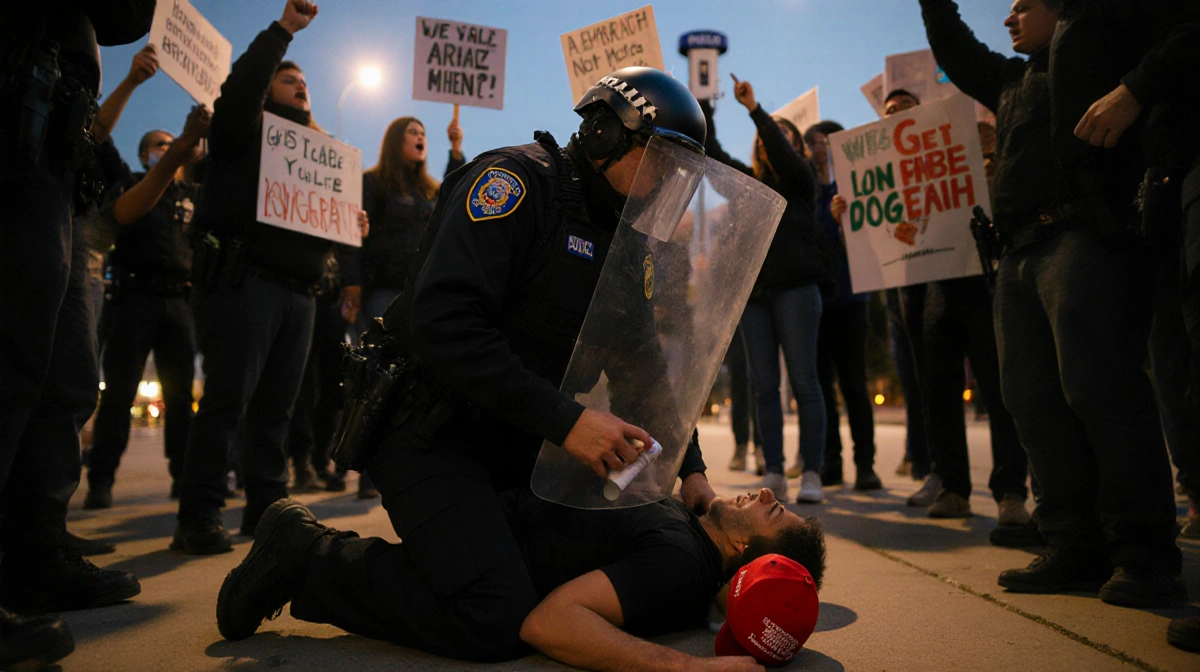
Another video shows agents following an employee who was recording them. After the employee yells “f— you,” an agent tackles him to the ground at the store entrance.
DHS commented on this arrest: “This individual was arrested for assaulting federal law enforcement officers under 18 U.S.C 111, assaulting, resisting, or impeding federal officers.”
Howard said both Target workers have been released “but sustained injuries and untold trauma while their rights were trampled for no reason whatsoever.”
Legal Challenge
Minnesota officials sued the federal government Monday to stop the deployment of thousands of immigration agents to the state.
“We continue to call on ICE to GET OUT of Minnesota,” Howard added.
Daniel J. Whitman reported from Minneapolis and New York.
Key Takeaways
Federal immigration officers have repeatedly used chemical agents against Minnesota residents protesting near the site of Renee Nicole Good’s fatal shooting by ICE.
The Department of Homeland Security plans to send more agents despite escalating tensions with local communities.
Minnesota officials have filed a federal lawsuit to block the deployment of thousands of additional immigration agents to the state.