
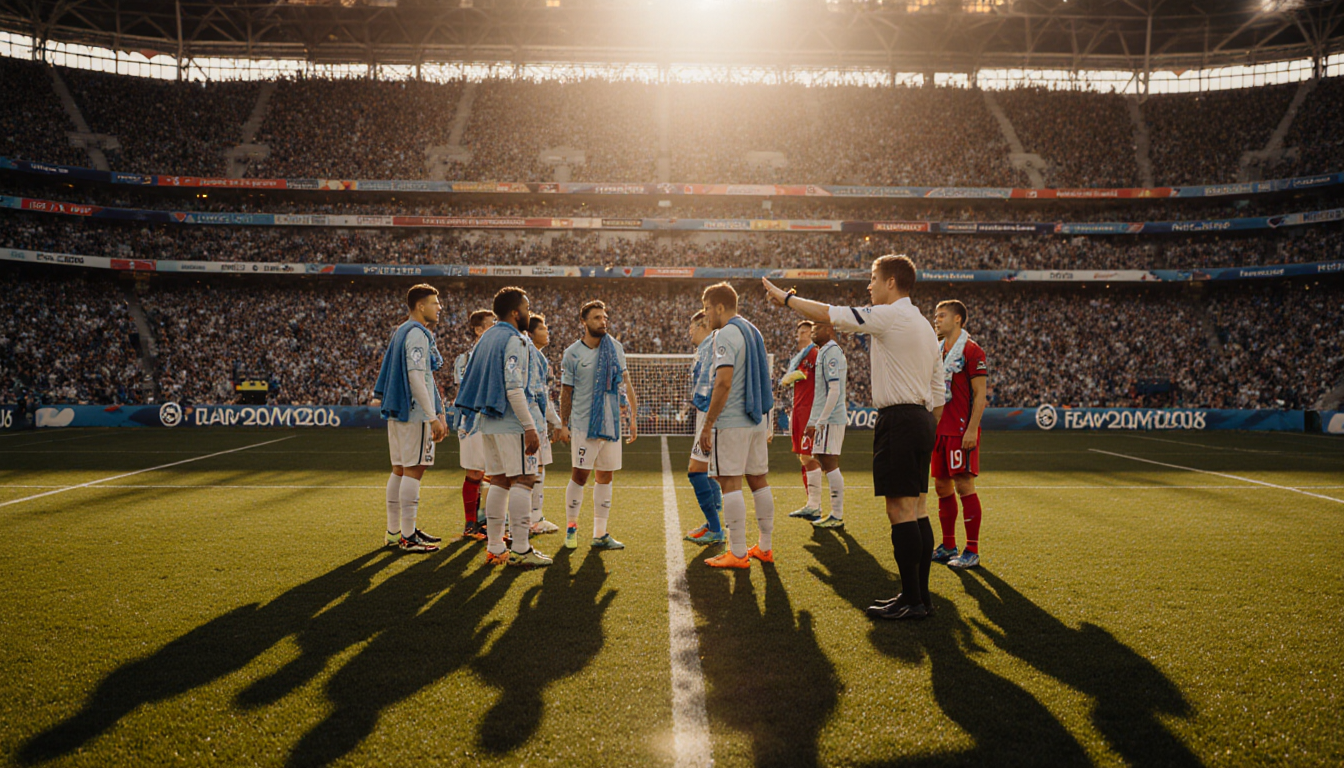

FIFA will stop play 22 minutes into each half of every 2026 World Cup match to give players a 3‑minute hydration break, a move that applies to all games regardless of weather or stadium features.

New Hydration Rule
The regulation requires referees to pause the match at the 22‑minute mark in both halves. Players will receive a short break of up to three minutes to drink water and use towels. The rule applies even if the temperature is below the previous 32°C (89.6°F) threshold. Stadiums across the United States, Canada, and Mexico must accommodate the pause.
Broadcaster and Scheduling Impact
FIFA said the change will make match schedules more predictable for broadcasters. Predictable breaks reduce uncertainty about when games will finish. This can improve advertising and programming plans for networks covering the event. The rule was first announced when Manolo Zubiria met with broadcasters.
Historical Context
The new rule replaces an earlier practice that only triggered after a 30‑minute interval and a temperature above 32°C. That system was used in past tournaments, but it was less consistent. FIFA noted the change was a streamlined version of the old approach.
Club World Cup Lessons
Heat and humidity affected players during this year’s Club World Cup held in the U.S. FIFA responded by lowering the temperature threshold for cooling breaks. The organization also installed more water and towels around the edge of the field to aid players.
Legal Pressure in 2014
In 2014, a Brazilian court ordered FIFA to make its recommended breaks mandatory or face fines. The ruling highlighted the growing concern over player safety in hot conditions. FIFA complied with the court’s directive by enforcing breaks.
Referee Flexibility
Manolo Zubiria said referees may have some flexibility if a stoppage occurs shortly before the 22‑minute mark. “This will be addressed on the spot with the referee,” Zubiria said. The rule allows referees to adjust the timing in exceptional circumstances.
Implementation Logistics
Stadiums must ensure that water stations and towels are ready for the scheduled break. Referees will use a countdown clock to signal the pause. Teams will be briefed on the new timing during pre‑match briefings. The break is scheduled to be as short as possible to minimize disruption.
Player and Medical Staff Perspective
Medical staff will be able to monitor player hydration levels during the break. Coaches can use the time to assess player readiness. Players will have a guaranteed opportunity to rehydrate, which may improve performance. The break also offers a moment for rest in hot climates.
Impact on Match Flow
The 3‑minute pause is designed to fit seamlessly into the flow of the game. It is short enough to avoid altering the rhythm of play. However, it introduces a predictable interruption that teams can plan around. Coaches will adjust substitution patterns accordingly.
Potential Criticisms
Some critics argue that the break could still be too short for effective rehydration. Others worry about the added complexity for referees. There is also concern that the rule might be used strategically by teams to disrupt opponents. FIFA has stated that the rule is aimed at player safety.
Key Takeaways
- FIFA will enforce a 3‑minute hydration break at the 22‑minute mark in each half.
- The rule applies to all 2026 World Cup matches, regardless of temperature or stadium features.
- Referees have flexibility to adjust the timing if a stoppage occurs just before the 22‑minute mark.
The new hydration regulation marks a significant step toward ensuring player safety and creating a more predictable broadcast schedule for the 2026 FIFA World Cup. All stakeholders—from players and coaches to broadcasters and stadium operators—will need to adapt to the new timing structure as the tournament approaches.