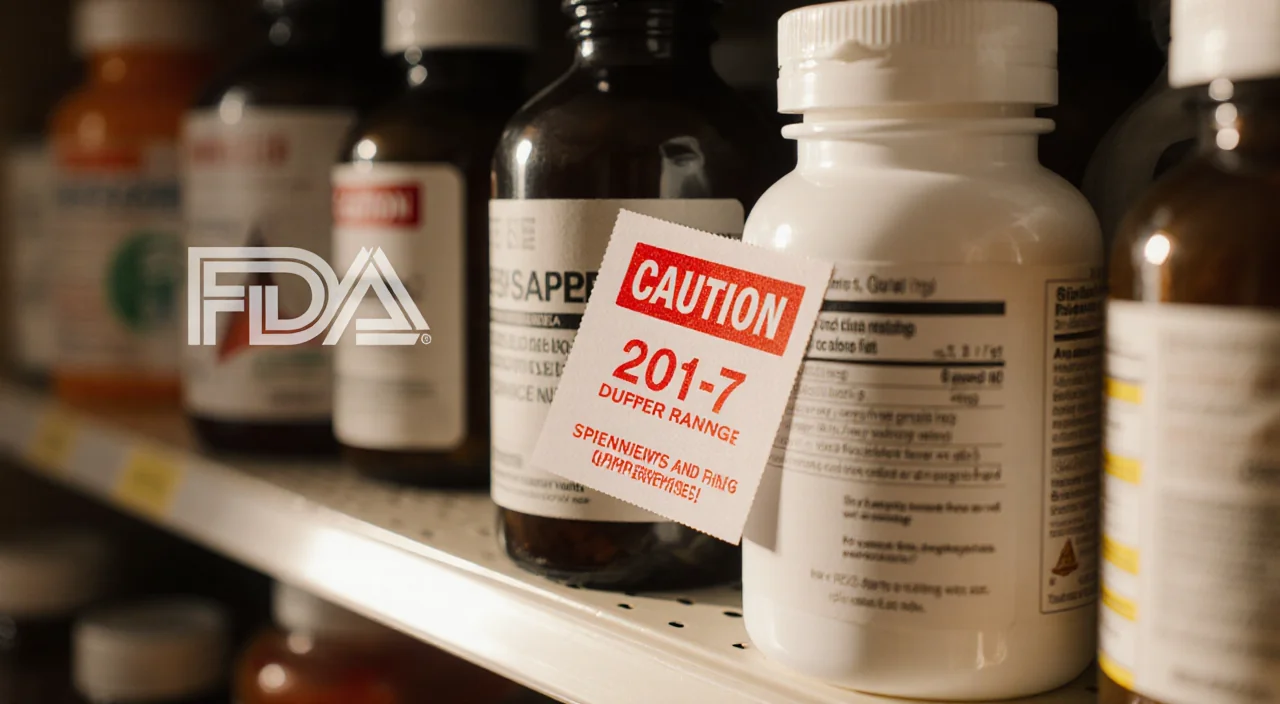

The FDA is weighing a proposal that could shrink the number of times dietary supplement warnings appear on packaging, a move that could make them harder to spot.
Proposed Rule Change
A letter sent to supplement manufacturers on Thursday outlined a potential rule that would keep the disclaimer on a product’s label only once, rather than repeating it with every health claim. Kyle Diamantas, head of the FDA’s food division, explained that the change would reduce label clutter and lower costs for companies. He added that the FDA has rarely enforced the current requirement and would suspend enforcement while the policy is reviewed. Diamantas wrote, “If FDA does not identify significant concerns as we continue our review of the available data and information regarding this request, we are likely to propose a rule to amend this requirement,” in the letter. The timing of any rule change remains unspecified, but the letter signals the agency’s intent to move forward.
Current Law and Disclaimer
The 1994 federal law mandates that supplement companies display a disclaimer whenever they make a health claim such as “supports immune health,” “promotes heart health,” or “better memory.” Under the law, the packaging must show in boldface type: “This statement has not been evaluated by the Food and Drug Administration. This product is not intended to diagnose, treat, cure, or prevent any disease.” This requirement applies to every instance of a benefit claim on the label. The proposed rule would keep the disclaimer on the label only once, regardless of how many claims are made. The change would therefore alter how often consumers see the warning.
FDA’s Rationale
Diamantas said the agency’s primary goal is to cut unnecessary clutter on supplement packaging. He noted that the current rule has rarely been enforced, suggesting that the warning is already seen as a formality. Reducing the frequency of the disclaimer could also lower production costs for manufacturers. The FDA would not enforce the existing requirement while it reviews the policy. The agency’s letter indicates that a rule amendment will be proposed only if no significant concerns are found during the review.
Industry and Consumer Impact
More than three-quarters of Americans take at least one supplement, according to the FDA. The United States sells as many as 100,000 supplement products in stores or online. Industry leaders argue that a single disclaimer linked to health claims with an asterisk or similar symbol is sufficient to inform consumers. Steve Mister, president and CEO of the Council for Responsible Nutrition, said the trade group “welcomed” the FDA’s clarification on warning labels. The group previously told the FDA that a single disclaimer on a supplement’s label is enough to meet federal law’s intent.
Expert Perspectives
Dr. Pieter Cohen, an associate professor of medicine at Harvard Medical School, warned that the rule change could be the first step toward making already weak supplement warnings even weaker. Cohen said, “Then you start saying things like, ‘We only need it on the actual bottle,’” he noted. “Then you say, ‘It only needs to be on the back.’ Then you let the print get smaller.” He also pointed out that supplements are not reviewed before sale, so products can contain different amounts of ingredients than listed or ingredients not listed at all. A 2023 paper by Cohen published in the Journal of the American Medical Association found that nearly nine out of ten melatonin gummy brands were inaccurately labeled. Cohen added, “This further undermines the ability of consumers to understand the true health effects,” he said.
Government and Political Context
Andrew Nixon, a spokesperson for the Department of Health and Human Services, said the change would not make it harder for consumers to notice the warning. He added that “a growing number of Americans are paying closer to attention to product labels.” Scott Gottlieb, a former FDA commissioner, said he wasn’t sure what it meant for consumers but a rule change means supplement makers wouldn’t have to make the DISCLAIMERS as prominent, possibly making them easier to miss. Health Secretary Robert F. Kennedy Jr., who has said he takes a wide range of supplements, said the Trump administration would move to free Americans from what he called the FDA’s “aggressive suppression” of vitamins and dietary supplements. Dr. Mehmet Oz, administrator of the Centers for Medicare and Medicaid Services, was criticized during his March confirmation hearing for promoting supplements described as a “magic weight loss cure” or a “miracle in a bottle.”
Key Takeaways
- The FDA is considering a rule that would keep the supplement disclaimer only once per product.
- The change could reduce how often consumers see the warning, potentially making it harder to notice.
- Industry, experts, and politicians have mixed reactions, with concerns about safety and cost.
While the FDA has not yet set a timeline, the agency’s letter signals a willingness to move forward with a streamlined disclaimer policy. The proposal has sparked debate among regulators, industry groups, and health experts about the balance between consumer protection and label simplicity.