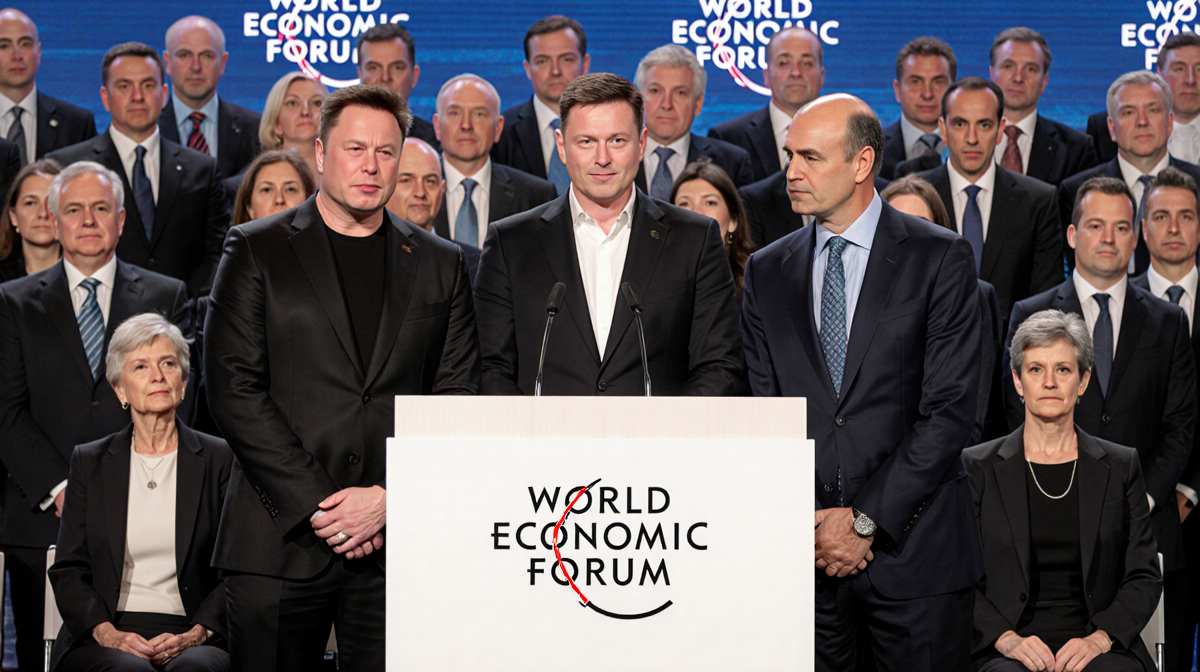
At this year’s World Economic Forum, AI leaders like Elon Musk, Satya Nadella, and Dario Amodei converged in Davos, sparking a flurry of public sniping and policy critique.
At a Glance
- CEOs of Tesla, Nvidia, Anthropic, Microsoft, and Meta dominated the main promenade.
- The event highlighted AI’s transformative promise while exposing fierce competition and trade disputes.
- Key moments included Anthropic’s attack on Nvidia’s China chip sales and Nadella’s push for broader AI adoption.
- Why it matters: The forum’s high-profile confrontations signal how AI giants are shaping global tech policy and market dynamics.
Tech Titans Take Center Stage
The week’s meeting transformed Davos into a high-powered tech conference. On-stage appearances by Tesla CEO Elon Musk, Nvidia CEO Jensen Huang, Anthropic CEO Dario Amodei, Microsoft CEO Satya Nadella, and Meta and Salesforce storefronts dominated the promenade.
Kirsten Korosec observed that topics such as climate change drew fewer crowds, while the main promenade was taken over by tech companies. She noted:
> “Some of the discussions around, let’s say, climate change or poverty and big global problems, [are] not really attracting the crowds. Meanwhile, on the main promenade in Davos, Switzerland, some of the biggest storefronts have been converted and taken over by companies like Meta and Salesforce, Tata, also a lot of Middle East countries. And I think the largest was the USA House, which was sponsored by McKinsey and Microsoft. It really felt visually different.”
Musk’s presence was a surprise; he had previously avoided Davos. “It was interesting that he showed up,” Sean O’Kane added.
CEO Rants and Rivalry
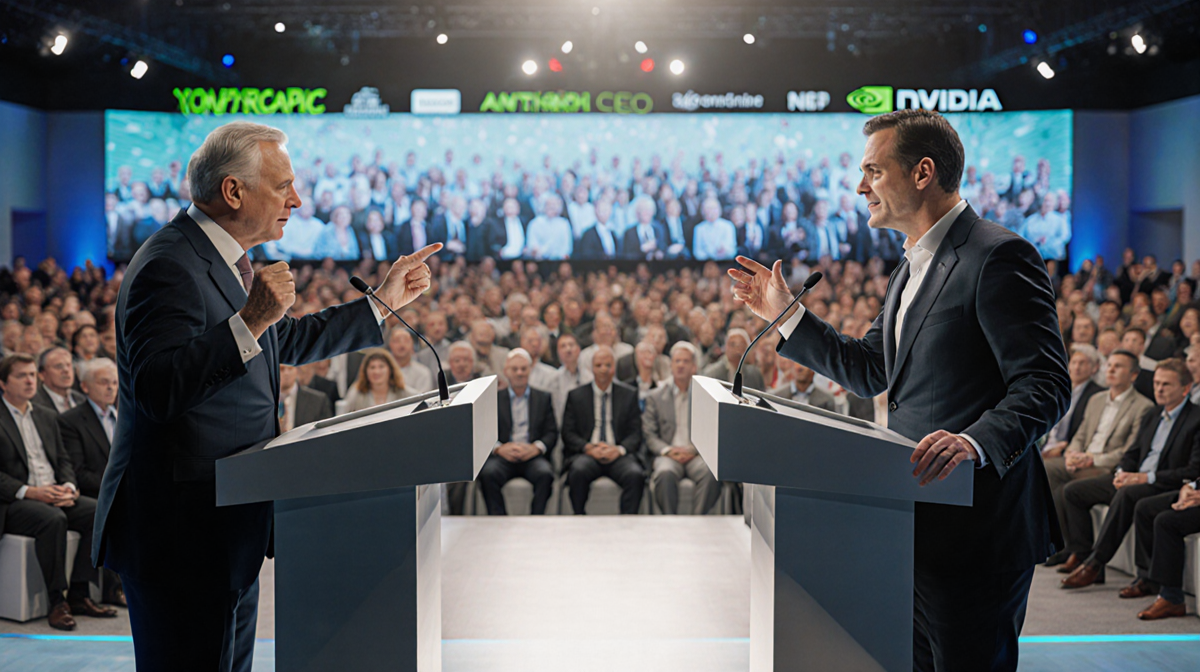
The forum was marked by public sniping among CEOs, a rare sight given their usual collaborative image. The tension was palpable, especially between Anthropic and Nvidia.
Anthropic vs. Nvidia
Anthropic’s Dario Amodei criticized the Trump administration’s decision to allow Nvidia to ship chips to China:
> “How could we possibly send all these chips to China if we’re worried about China? Because essentially we’re sending a country full of geniuses over to China and letting them control it.”
Amodei’s comment tied the tech dispute to broader trade and political concerns.
Satya Nadella’s Take
Nadella warned that without widespread usage, AI could become a bubble:
> “More people need to be using this or else it’s going to be a bubble and a popped bubble.”
He contrasted this with Amodei’s focus on equitable AI distribution, emphasizing a need to avoid concentration in wealthy regions.
Jensen Huang’s Call
Huang echoed a similar sentiment, urging more investment:
> “We’re not investing enough in this and we need more investment to be able to make this work.”
Huang also linked AI growth to job creation, noting that the build-out may slow but the conversation is still focused on expansion.
Trade and Policy Tensions
The forum highlighted how AI is intertwined with international trade and geopolitics. The Anthropic-Nvidia clash exemplified this intersection.
| CEO | Company | Key Point | Context |
|---|---|---|---|
| Dario Amodei | Anthropic | Criticized Nvidia’s China chip sales | Trade policy conflict |
| Satya Nadella | Microsoft | Urged broader AI usage to avoid bubble | Market strategy |
| Jensen Huang | Nvidia | Demanded more investment | Capital allocation |
These statements reflect the leaders’ attempts to balance market dominance with global policy considerations.
Takeaways
- Competitive friction among AI leaders is more visible than ever, with public criticisms spilling onto the forum stage.
- Trade disputes over chip sales to China remain a flashpoint, influencing corporate strategies.
- Market expansion is seen as essential to avoid a bubble, yet leaders differ on how to achieve equitable distribution.
- The event underscores how AI giants are not just tech innovators but also key players in shaping global policy.
The week at Davos illustrated that AI’s future will be defined not only by technological breakthroughs but also by the power dynamics among its biggest corporate players.