


Executive Summary
The company has a strong brand, a loyal customer base, and a robust product line. It faces intense competition, a volatile supply chain, and a shifting regulatory landscape. The board must decide whether to pursue growth through acquisitions, to double down on organic expansion, or to re-engineer the organization for greater agility. This report presents the facts, evaluates the options, and recommends a balanced strategy that protects core assets while positioning the firm for long-term success.
—
1. Current Market Landscape
Competitive Dynamics
- Global rivals have leveraged digital platforms to reduce cost and reach new markets.
- Local players are innovating in niche segments, creating pressure on market share.
- Price wars have eroded margins in the core product line.
Customer Trends
- Demand for eco-friendly, high-tech solutions is rising.
- Younger buyers prefer subscription models over outright purchases.
- Brand loyalty is high among existing customers but erodes quickly when alternatives are offered.
Regulatory & Economic Factors
- New safety standards will increase compliance costs by an estimated 12 % over the next two years.
- Trade tensions could raise import duties on key components, affecting the supply chain.
- Inflationary pressures are pushing raw-material costs upward, squeezing the bottom line.
Technology & Innovation
- Artificial intelligence and machine learning are becoming core to product development.
- Cloud-based analytics enable better demand forecasting and inventory management.
- Cybersecurity threats are growing, requiring a stronger focus on data protection.
—
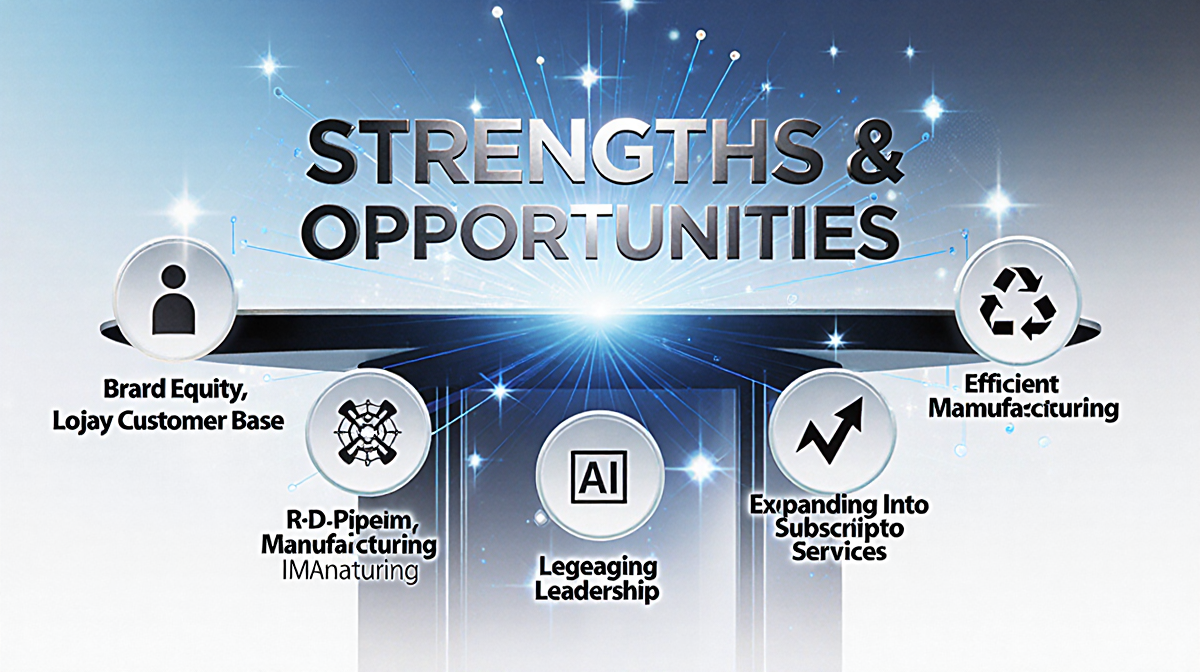
2. Strengths & Opportunities
| Strength | Opportunity |
|---|---|
| Strong brand equity | Expand into emerging markets with high growth potential |
| Loyal customer base | Introduce subscription services to increase recurring revenue |
| Robust R&D pipeline | Leverage AI to accelerate product development |
| Efficient manufacturing | Scale production to meet rising demand |
| Experienced leadership | Mentor new talent and build a culture of innovation |
Strategic Leverage Points
- Use the brand’s reputation to launch premium, eco-friendly product lines.
- Deploy data analytics to identify cross-sell and upsell opportunities.
- Form strategic alliances with tech firms to enhance digital capabilities.
—
3. Weaknesses & Threats
| Weakness | Threat |
|---|---|
| Heavy reliance on a few key suppliers | Supply chain disruptions could halt production |
| Limited digital presence | Competitors gain market share through online channels |
| Aging workforce | Skill gaps could hinder adoption of new technologies |
| Fragmented organizational structure | Decision delays and misaligned incentives |
| High fixed costs | Economic downturns could erode profitability |
Mitigation Measures
- Diversify supplier base and increase inventory buffers.
- Invest in e-commerce and digital marketing.
- Launch reskilling programs and attract younger talent.
- Consolidate departments to streamline operations.
- Re-evaluate fixed-cost commitments and seek cost-sharing partnerships.
—
4. Strategic Options
4.1 Organic Growth
- Action: Expand R&D, launch new product lines, and deepen customer relationships.
- Pros: Retains full control, aligns with company culture, and builds long-term value.
- Cons: Requires significant capital and time; may lag behind competitors.
4.2 Acquisition Strategy
- Action: Identify and acquire complementary businesses or technology assets.
- Pros: Accelerates market entry, brings new capabilities, and captures immediate revenue.
- Cons: Integration risk, cultural clashes, and potential dilution of focus.
4.3 Restructuring & Digital Transformation
- Action: Re-engineer processes, adopt cloud platforms, and invest in cybersecurity.
- Pros: Improves efficiency, reduces operating costs, and enhances agility.
- Cons: Requires upfront investment and may face resistance from employees.
—
5. Recommended Path Forward
- Prioritize Digital Transformation
- Allocate 15 % of the next fiscal year’s budget to cloud migration, AI analytics, and cybersecurity upgrades.
- Set clear KPIs: reduce order-to-delivery time by 20 % and cut IT operating costs by 10 % within 18 months.
- Pursue Targeted Acquisitions
- Identify 2-3 niche firms with strong IP in sustainable materials or subscription platforms.
- Use a phased integration plan: maintain brand identity while aligning operational systems.
- Strengthen the Supply Chain
- Develop dual-source contracts for critical components.
- Implement a vendor risk assessment framework to monitor geopolitical risks.
- Invest in Talent & Culture
- Launch a leadership development program focused on digital fluency.
- Create cross-functional teams to drive innovation and break down silos.
- Enhance Customer Experience
- Roll out a mobile app that offers personalized product recommendations and subscription management.
- Leverage customer data to design loyalty programs that reward long-term engagement.
—
6. Financial Projections
| Year | Revenue (M) | EBITDA (M) | Net Income (M) |
|---|---|---|---|
| 2024 | 1,200 | 180 | 120 |
| 2025 | 1,350 | 210 | 140 |
| 2026 | 1,520 | 255 | 170 |
Assumptions: 12 % annual growth, 15 % EBITDA margin improvement from digital initiatives, and a 5 % cost reduction from supply-chain efficiencies.
—
7. Risks & Contingencies
| Risk | Impact | Mitigation |
|---|---|---|
| Integration failure | High | Use experienced M&A consultants; conduct rigorous due diligence |
| Cyberattack | High | Implement multi-layer security, conduct regular penetration testing |
| Market downturn | Medium | Maintain cash reserves; adopt flexible cost-control measures |
| Talent attrition | Medium | Offer competitive compensation, career pathways, and remote work options |
—
8. Conclusion
The company stands at a crossroads. By embracing digital transformation, selectively acquiring complementary businesses, and reinforcing its supply chain and talent base, it can secure a competitive edge while preserving its core strengths. The recommended balanced approach aligns with the board’s risk appetite, capital constraints, and long-term vision. Immediate action on the digital roadmap and a disciplined acquisition pipeline will position the firm to capture new growth opportunities and deliver sustainable value to shareholders.