
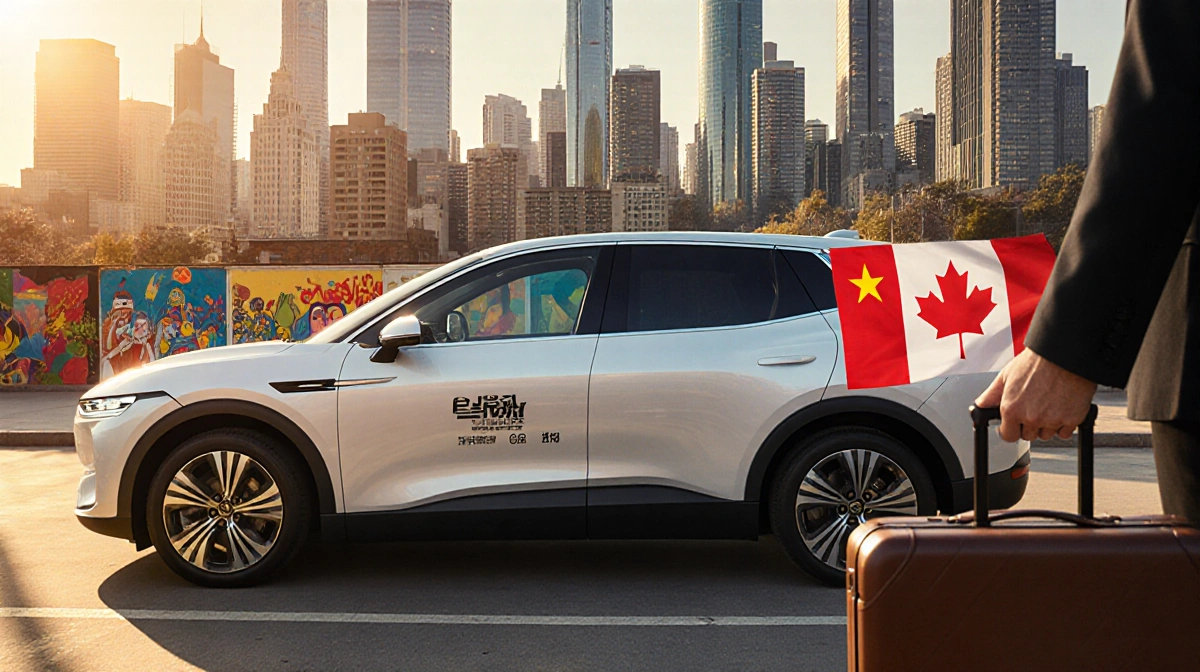

Canada will drop its 100% import tax on Chinese electric vehicles to 6.1%, Prime Minister Mark Carney announced Friday, opening a new gateway for Chinese brands into North America.
At a Glance
- Canada cuts Chinese EV tariff from 100% to 6.1%
- Annual import cap starts at 49,000 vehicles, rising to 70,000 in five years
- Move follows similar debates in the EU and contrasts with continued U.S. resistance
- Why it matters: North American consumers could soon see cheaper, tech-rich Chinese EVs on Canadian roads, pressuring domestic automakers
The policy shift gives companies like Geely, BYD, and Xiaomi a regulated but viable path into the continent. Shipments will initially be limited to 49,000 vehicles per year, edging up to roughly 70,000 within five years, according to the Associated Press.
A Controlled Opening
Ottawa is balancing trade liberalization with market protection. By capping volumes, officials hope to gauge economic impact without unleashing a flood of lower-cost imports. The graduated ceiling also offers Canadian suppliers time to adjust should demand surge.
China, facing softer domestic sales, has been scouting export growth. The European Union is weighing its own tariff reductions, while the United States maintains steep barriers. President Trump this week said he might welcome Chinese factories on U.S. soil, but not finished-car imports.
Chinese Brands Eye the Continent
Many leading Chinese EV-makers have long targeted North America. Geely, which staged a drive event at January’s Consumer Electronics Show in Las Vegas, signaled it hopes to announce U.S. market entry within two-to-three years, according to a company communications manager. Though the showcased models were technically destined for Mexico, the messaging was unmistakable.
Exports of Chinese gasoline, hybrid, and battery-electric vehicles to Mexico have already soared in 2025, establishing supply-chain footholds south of the U.S. border.
Price Advantage Meets Quality Gains
Chinese EVs typically retail far below the average price of cars in the U.S., achieved through low capital costs, competitive labor rates, and aggressive market-share strategies. The quality gap has also narrowed. Industry observers, influencers, and executives-including Ford CEO Jim Farley-have publicly praised recent Chinese models for fit, finish, and technology integration.

Security Concerns Remain
Washington continues to restrict Chinese-connected vehicles, citing national-security risks. Last year the Commerce Department’s Bureau of Industry and Security finalized a rule limiting import and sale of certain connected-vehicle hardware and software tied to China or Russia. Bipartisan unease focuses on data collection and potential remote-control vulnerabilities.
Industry Pushback
Avery Ash, CEO of the nonprofit Securing America’s Future Energy, warned that letting Chinese automakers build-or even export heavily-into North America could undermine domestic manufacturing and defense supply chains.
“We’ve seen this strategy backfire in Europe and elsewhere-it would have potentially catastrophic impacts on our automotive industry, have ripple effects on our entire defense industrial base, and make every American less secure,” Ash said Thursday. He urged President Trump to “stay tough against China and protect American auto manufacturers and workers.”
What Comes Next
With Canada’s tariff wall largely dismantled but import quotas in place, Chinese EV brands are expected to prioritize Canada as a test bed for North American consumer preferences, charging behavior, and after-sales support. Analysts say success there could strengthen their lobbying position for eventual U.S. market access, especially if domestic production partnerships materialize.
For Canadian consumers, the first wave of lower-priced Chinese EVs could arrive as early as this year, subject to automaker homologation and dealer networks. The federal government has pledged to review the quota annually, leaving room to tighten-or further loosen-market access depending on economic and geopolitical conditions.