
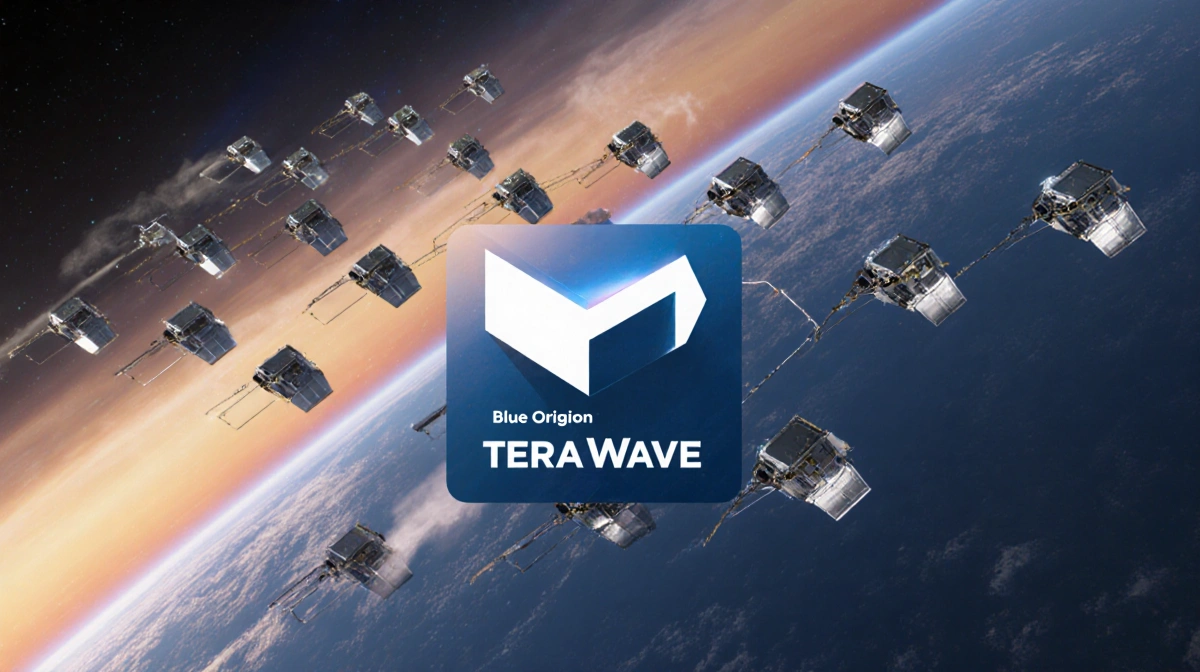

Blue Origin has formally entered the satellite internet race with TeraWave, a high-throughput constellation promising enterprise-grade speeds of up to 6 terabits per second-15,000 times faster than today’s consumer Starlink service.
At a Glance
- 5,280 low-Earth-orbit plus 128 medium-Earth-orbit satellites
- First launches slated for late 2027
- Optical links on MEO craft deliver headline 6Tbps speed
- Why it matters: A second Bezos-backed network could break SpaceX’s current dominance among governments and data-center operators
The new venture, revealed quietly via a website that went live this week, targets data-center operators, large enterprises, and government agencies rather than everyday consumers. Blue Origin’s statement to News Of Philadelphia frames TeraWave as “a space-based layer to your existing network infrastructure, providing connectivity to locations unreachable by traditional methods.”
How TeraWave Will Work
The architecture splits traffic between two orbital shells:
| Orbital Layer | Satellite Count | Link Type | Max Speed per Satellite |
|---|---|---|---|
| Low-Earth | 5,280 | RF | 144 Gbps |
| Medium-Earth | 128 | Optical | 6 Tbps |
Low-Earth craft will handle broader coverage using proven radio-frequency links, while the smaller medium-Earth fleet will fire optical beams between satellites and ground gateways to hit the blistering headline rate. By contrast, SpaceX’s current Starlink satellites top out at roughly 400 Mbps, though the company has signaled future upgrades to 1 Gbps.
Blue Origin has not disclosed how long the full deployment will take, nor the exact launch cadence after the first satellites leave Earth in late 2027.
A Two-Front Bezos Strategy
TeraWave is the second orbital internet project linked to Jeff Bezos. Amazon’s previously announced Leo network-about 3,000 consumer-facing satellites-was rebranded only months ago. Together, the two platforms could present a coordinated challenge to Starlink, which serves more than 9 million customers across consumer, commercial, and government tiers.
Blue Origin stressed that TeraWave and Leo remain “distinct” efforts, each optimized for different market segments.

> “We identified an unmet need with customers who were seeking enterprise-grade internet access with higher speeds, symmetrical upload/download speeds, more redundancy, and rapid scalability for their networks. TeraWave solves for these problems,” the company said.
From Tourism to Telecom
Until now, Blue Origin’s public identity centered on sub-orbital tourism aboard the New Shepard rocket. Over the past year, however, the firm has accelerated toward a multi-product space portfolio:
- 2025: maiden and repeat flights of the heavy-lift New Glenn rocket
- 2025: first successful booster recovery on only the second attempt
- 2026: planned lunar landing mission on the third New Glenn flight
Adding “satellite manufacturer and operator” to that résumé positions Blue Origin to capture revenue across launch, spacecraft, and now services.
Competitive Landscape
Starlink’s early lead gives it formidable scale, yet the market for dedicated enterprise bandwidth remains open. TeraWave’s promise of symmetrical, multi-gigabit links with global reach could lure institutions that need redundant, high-capacity backhaul beyond the reach of fiber.
No pricing or service tiers have been released; Blue Origin says additional details will follow as the first launch window approaches.
Key Takeaways
- Blue Origin’s TeraWave will field 5,408 satellites split between two orbital shells
- Optical inter-satellite links enable record-setting 6Tbps throughput
- First hardware heads to space in late 2027, with full deployment timeline still under wraps
- The new network complements Amazon’s Leo constellation in a dual Bezos effort to erode SpaceX’s satellite internet dominance