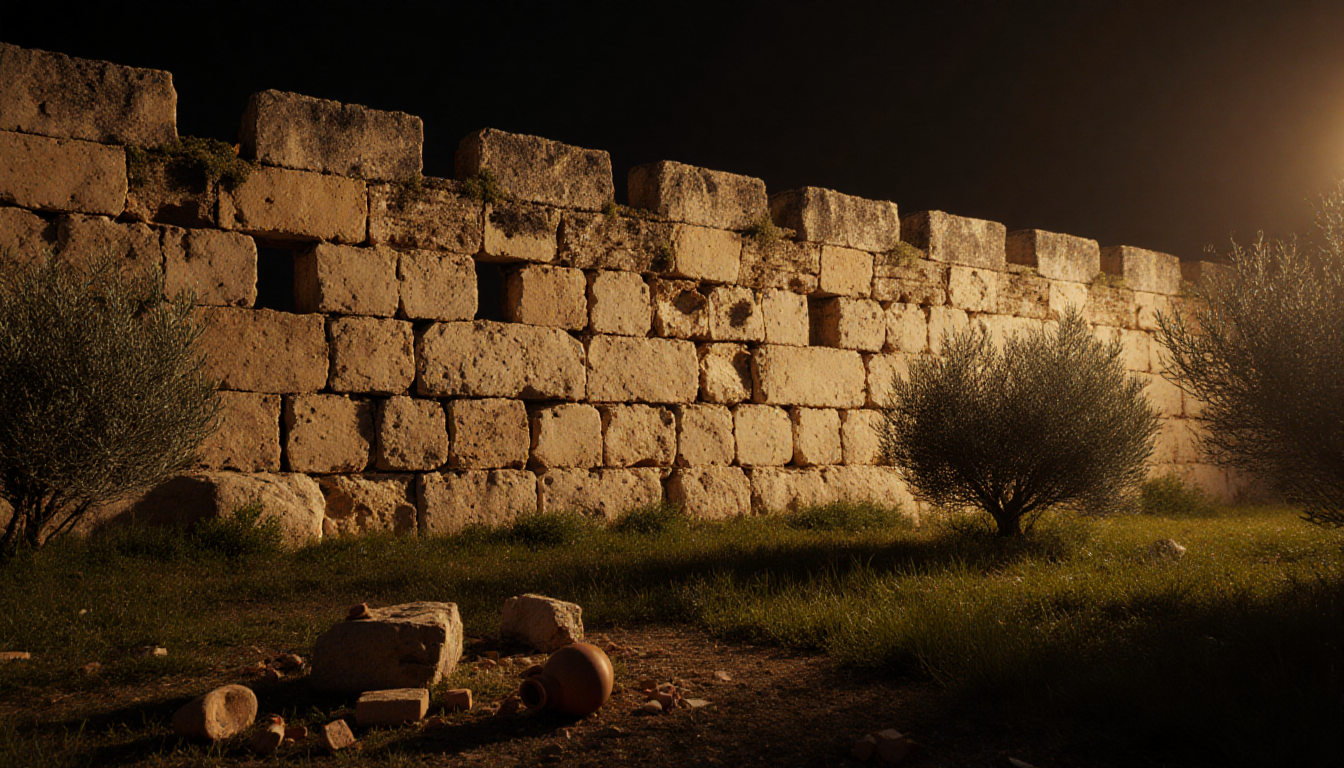

In a remarkable excavation that reached the end of a long‑running dig, archaeologists finished uncovering the most complete segment ever found of the foundations of Jerusalem’s Hasmonean wall. The work, which concluded last week, revealed a 164‑foot stretch of wall that once encircled the city during the era of the Hasmonean Kingdom.
The Discovery
The wall, built a few decades after the events of Hanukkah, measures roughly half the length of a football field and is about 16 feet wide. According to estimates and ancient writings, the walls that stood on top of this foundation would have been taller than the current walls surrounding Jerusalem’s Old City. The Hasmonean fortification encompassed an area larger than the present Old City and featured 60 watchtowers, each exceeding 33 feet in height.
The excavation took place beneath an abandoned wing of the Kishleh, a building erected in 1830 as a military base. The wing had served as a prison, including during British rule up to the 1940s, and its walls bore graffiti carved by prisoners in English, Hebrew and Arabic. The remnants of the iron bars from the cells remain visible in the ceiling.
A Possible Ceasefire in Stone
One of the most intriguing aspects of the foundation is that the wall above it appears to have been dismantled intentionally and uniformly to a consistent height. Dr. Amit Re’em, a lead archaeologist from the Israel Antiquities Authority, explained that such an action would be unusual for a security wall in a region constantly threatened by invasion.
Re’em cited ancient historian Flavius Josephus to support the theory that the wall’s removal was part of a negotiated ceasefire. He said: “Antiochus Sidetes (the Seventh) reached a ceasefire agreement with John Hyrcanus, saying, if you want me to remove my army, you yourself, the Jewish king, must raze to the ground the Hasmonean fortification that you and your father built,” Re’em said Monday. Josephus’s account notes that after Antiochus accepted Hyrcanus’s deal, they “pulled down the walls encircling the city.”
Re’em added, “We just think that we found the archaeological proof for it, so it’s pretty amazing, the archaeology and the ancient stories combining together, this is the magic of Jerusalem.”
Alternative Interpretations
Other scholars suggest the dismantled section may have been cleared to accommodate King Herod’s palace, built over the Hasmonean foundations in the first century B.C. Orit Peleg‑Barkat, head of classical archaeology at the Hebrew University of Jerusalem, argued that the removal was likely related to Herod’s construction rather than the ceasefire. She noted that other parts of the wall remain intact, implying that only a specific section was taken down.
Peleg‑Barkat emphasized that it would be unlikely for Jerusalem to have been left without any defensive walls for more than a century. “It’s unlikely that Jerusalem was left unprotected without any security walls for more than a century,” she said.
From the Kishleh to the Tower of David
Archaeologists began excavating the Kishleh wing in 1999, but work was halted during the Second Intifada that began in 2000. The dig resumed two years ago after the violence subsided. Over the past two years, teams removed the equivalent of two Olympic swimming pools of dirt and debris by hand.
During the excavation, they uncovered what they believe are Middle‑Age‑era dye pits, likely used for fabric dying, alongside the long section of the Hasmonean wall foundation. The current section of the wall was found beneath the abandoned wing, and the site is now slated for public display.
In the coming years, the Tower of David Museum plans to install a floating glass floor over the ruins and incorporate the hall into its new Schulich Wing of Archaeology, Art and Innovation. The museum’s renovations are expected to take at least two years now that the archaeological dig has concluded.
Key Takeaways
- The longest intact Hasmonean wall section, 164 feet long, has been fully uncovered in Jerusalem.
- Evidence suggests the wall was deliberately dismantled, possibly as part of a 2,100‑year‑old ceasefire negotiated between Antiochus Sidetes and John Hyrcanus.
- The site, located beneath the Kishleh prison wing, will soon be integrated into the Tower of David Museum’s new galleries.
The completion of this excavation offers a tangible link between ancient texts and physical evidence, shedding new light on Jerusalem’s layered history and the complex dynamics of power, conflict, and diplomacy that shaped the city.