


At a Glance
- ChatGPT solved a long-standing Paul Erdős problem after 15 minutes of reasoning
- 11 of the 15 recently solved Erdős conjectures now credit AI models
- Renowned mathematician Terence Tao predicts AI will dominate the “long tail” of easier problems
Why it matters: AI is moving beyond assistance to autonomous mathematical discovery, potentially accelerating breakthroughs in pure mathematics.
Over the weekend, software engineer and startup founder Neel Somani tested OpenAI’s latest model on unsolved math problems and witnessed something extraordinary. After pasting a complex proof challenge into ChatGPT and letting it run for 15 minutes, he returned to find a complete, verifiable solution.
Somani had been benchmarking how large language models handle open mathematical problems. The model not only solved the problem but also formalized the proof using the Harmonic tool, demonstrating a level of mathematical reasoning that surprised even seasoned researchers.
Inside the Breakthrough
ChatGPT’s solution process showcased sophisticated mathematical thinking. The model referenced advanced concepts including Legendre’s formula, Bertrand’s postulate, and the Star of David theorem. It discovered a 2013 Math Overflow post where Harvard mathematician Noam Elkies had addressed a similar problem, then built upon that foundation to create a more complete solution to an Erdős variant.
The Erdős problems represent over 1,000 unsolved conjectures by the legendary Hungarian mathematician, maintained online as a benchmark for mathematical progress. These problems vary widely in difficulty and subject matter, making them an ideal testing ground for AI capabilities.
Rapid Progress Since GPT 5.2
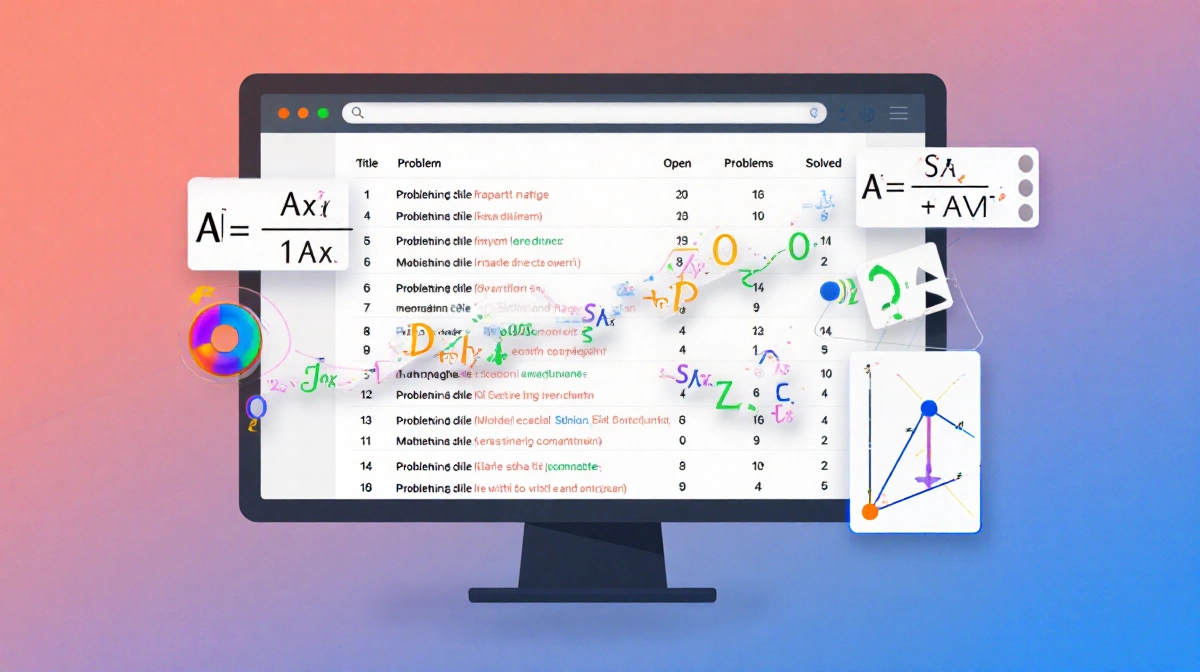
The release of GPT 5.2 marked a turning point. Somani describes this version as “anecdotally more skilled at mathematical reasoning than previous iterations.” Since Christmas, the Erdős website has moved 15 problems from “open” to “solved,” with AI models contributing to 11 of those solutions.
This acceleration follows earlier progress in November, when the Gemini-powered AlphaEvolve model began tackling these challenges. The combination of improved language models and formalization tools like Lean and Harmonic’s Aristotle has created a new paradigm for mathematical discovery.
Mathematicians Take Notice
Terence Tao, one of the world’s most respected mathematicians, has been tracking AI progress on his GitHub page. His analysis shows:
- 8 problems where AI made meaningful autonomous progress
- 6 problems solved by locating and building on previous research
Tao sees particular promise in applying AI to what he calls the “long tail” of easier Erdős problems. On Mastodon, he noted that many of these actually have straightforward solutions, making them prime targets for AI methods rather than human or hybrid approaches.
The Formalization Revolution
A key enabler is the shift toward formalization-converting mathematical proofs into computer-verifiable formats. While formalization doesn’t require AI, automated tools have dramatically accelerated the process. Lean, developed at Microsoft Research in 2013, has become the standard proof assistant, while newer AI tools promise to automate much of the labor-intensive work.
Tudor Achim, founder of Harmonic, emphasizes that the real breakthrough isn’t just the number of solved problems-it’s that leading mathematicians are embracing these tools. “I care more about the fact that math and computer science professors are using [AI tools],” Achim explained. “These people have reputations to protect, so when they’re saying they use Aristotle or they use ChatGPT, that’s real evidence.”
Beyond Human Limitations
The scalable nature of AI systems gives them unique advantages in systematic problem-solving. Unlike human mathematicians who might focus on high-profile challenges, AI can methodically work through hundreds of smaller problems, potentially uncovering connections humans might miss.
This represents a fundamental shift from AI as a tool for mathematicians to AI as an independent mathematical researcher. While human oversight remains crucial for validating results and providing creative direction, the autonomous problem-solving capability demonstrated by recent successes suggests a new era in mathematical discovery.
Key Takeaways
- ChatGPT solved an open Erdős problem in 15 minutes, marking a milestone in AI mathematical reasoning
- 11 of 15 recently solved Erdős conjectures now credit AI involvement
- Leading mathematicians predict AI will increasingly solve problems humans find too obscure or time-consuming
- Formalization tools like Lean and Aristotle are making AI-generated proofs verifiable and extensible