
At a Glance
- Wikipedia’s parent signs paid-content deals with Amazon, Meta, Microsoft, Mistral AI, and Perplexity
- Google partnership from 2022 now joined by eight total enterprise customers
- 15 billion monthly page views across 65 million articles in 300+ languages
- Why it matters: The foundation secures new revenue as AI firms mine its human-edited knowledge base
Wikipedia is turning its freely edited encyclopedia into a paid enterprise product, announcing fresh licensing agreements with some of the world’s biggest technology and AI companies as it marks 25 years since launch.
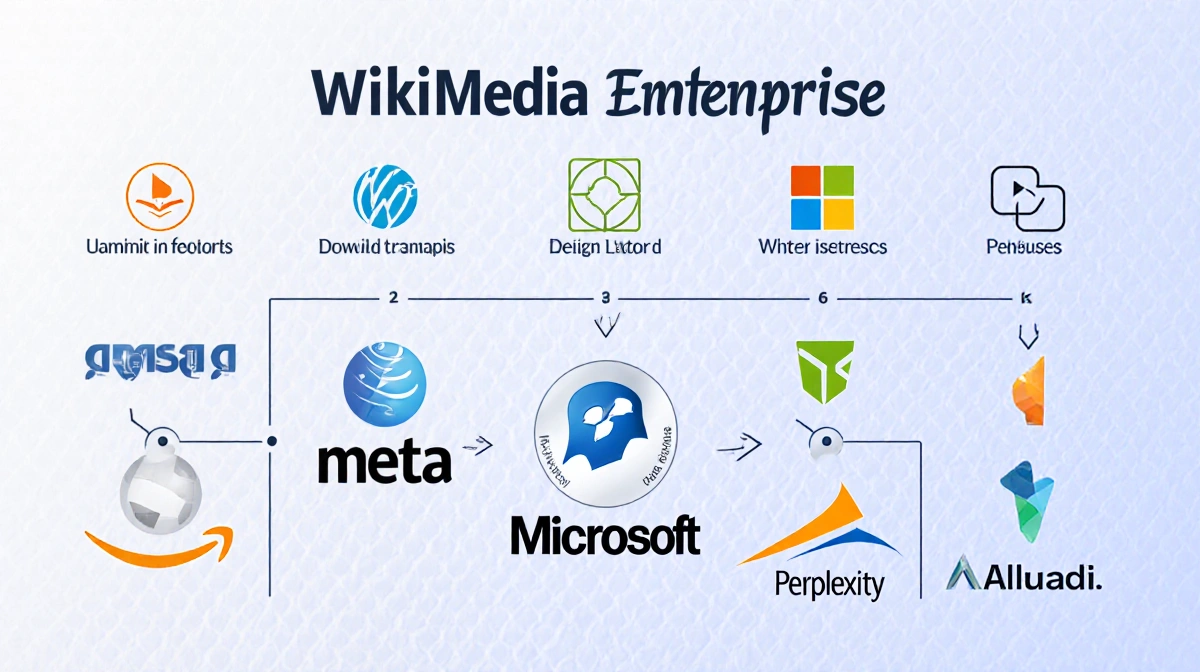
The Wikimedia Foundation revealed the deals in a blog post timed to the site’s birthday on January 15, disclosing that Amazon, Meta, Microsoft, Mistral AI, and Perplexity have all become paying customers of Wikimedia Enterprise within the past year. The foundation previously disclosed only a 2022 agreement with Google.
How Wikimedia Enterprise Works
Wikimedia Enterprise repackages Wikipedia and sister projects into high-speed, high-volume data feeds designed for corporate use. Customers gain:
- Real-time access to article updates
- Structured data optimized for machine learning
- Legal certainty for large-scale reuse
- Dedicated support channels
The foundation says the product solves a practical problem: technology companies already scrape Wikipedia content to power search answers, voice assistants, and AI models. Enterprise contracts convert that usage into predictable revenue while guaranteeing service levels.
Full Customer Roster
Alongside the newly public partners, the foundation re-listed several existing customers:
- Google – original 2022 deal
- Ecosia – privacy-focused search engine
- Pleias – French data consultancy
- ProRata – AI attribution startup
- Nomic – open-source AI firm
- Reef Media – content syndicator
The combined list shows Wikipedia content feeding search engines, social media, chatbots, and specialized research tools.
Traffic Scale
The foundation used the announcement to restate Wikipedia’s reach:
| Metric | Figure |
|---|---|
| Monthly page views | ~15 billion |
| Active articles | 65 million+ |
| Languages | 300+ |
| Global website rank | Top 10 |
The numbers underline why large platforms treat the encyclopedia as critical infrastructure for factual queries.
Leadership Quote
Selena Deckelmann, the foundation’s Chief Product and Technology Officer, framed the deals as essential to preserving human knowledge in an AI era.
“Wikipedia shows that knowledge is human, and knowledge needs humans. Especially now, in the age of AI, we need the human-powered knowledge of Wikipedia more than ever,” Deckelmann said.
She added that continued support from readers, volunteer editors, donors, and commercial partners will keep Wikipedia “the crucial hub for human-powered knowledge and collaboration online for the next 25 years and beyond.”
Birthday Campaign
Beyond commercial news, the foundation launched a multi-part celebration:
- Video docuseries – behind-the-scenes profiles of volunteer editors worldwide
- Time-capsule site – interactive timeline narrated partly by founder Jimmy Wales
- Livestream party – scheduled for January 15 at 4:00 PM UTC on YouTube, TikTok, and Instagram
- Games and short-form video experiments – new formats aimed at younger audiences
The organization also touted recent infrastructure upgrades and internal AI projects, though it gave no specifics.
Revenue Context
Wikimedia Enterprise represents the foundation’s most direct attempt to monetize its content without erecting paywalls for readers. Traditional fundraising banners still generate the majority of the organization’s $180 million annual budget, but enterprise licensing diversifies income and capitalizes on commercial demand for curated, multilingual data.
Key Takeaways
- Wikipedia now charges eight tech companies for structured access to its content
- Newly disclosed partners include Amazon, Meta, Microsoft, Mistral AI, and Perplexity
- The foundation positions the product as both revenue stream and quality safeguard
- Birthday festivities aim to spotlight volunteer editors who create the knowledge base