

President Donald Trump’s repeated threats to seize control of Greenland are straining relations with U.S. allies in NATO and have sparked a warning that doing so by force could spell the end of the world’s biggest security alliance.
At a Glance
- Trump vowed “One way or the other, we’re going to have Greenland” and the White House has not ruled out military force
- Danish Prime Minister Mette Frederiksen warned a U.S. attack on Greenland would end Denmark’s NATO membership
- NATO’s Article 5 collective-defense pledge has never been tested against an internal conflict among allies
- The alliance has no established mechanism to handle a fight between two members
Why it matters: A U.S. move to annex allied territory could shatter the 75-year-old NATO alliance that has underpinned European and North-American security.
Tensions have routinely spiked among some of NATO’s members over the decades, notably between neighbors Greece and Turkey. But it would set a dangerous precedent should its most powerful country, the United States, annex the territory of another ally.
Greenland is a semi-autonomous island that is part of the Danish realm. Danish Prime Minister Mette Frederiksen has warned that “if the United States chooses to attack another NATO country militarily, then everything stops … including our NATO.”
NATO’s Founding Purpose
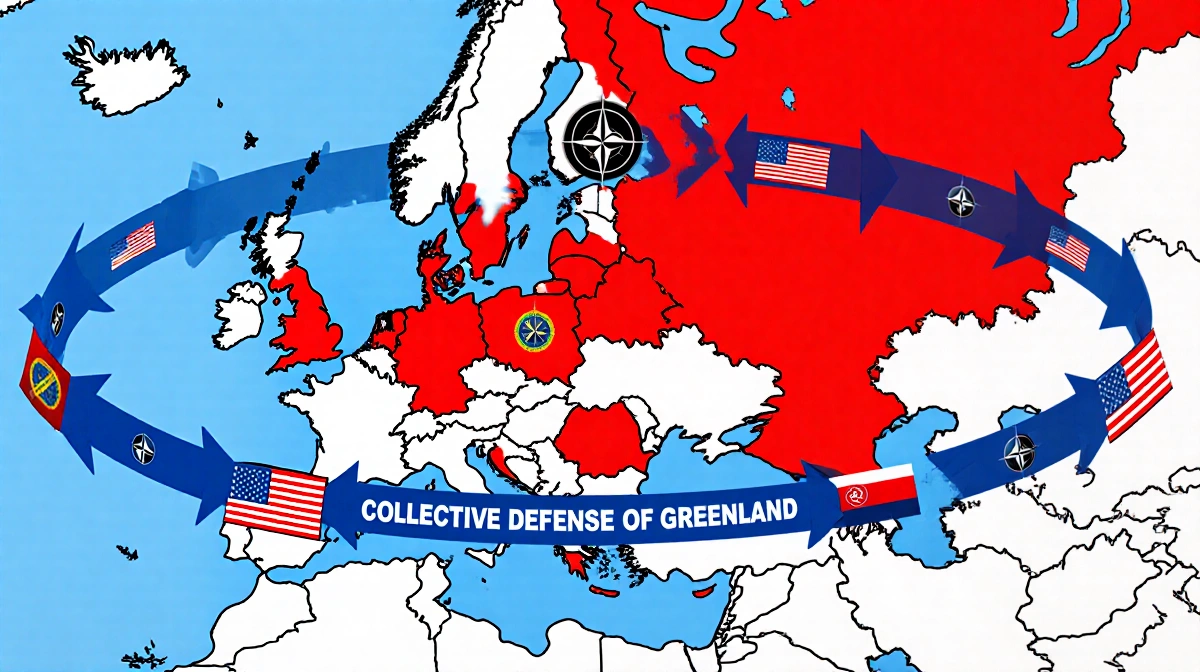
The North Atlantic Treaty Organization was formed by 12 nations in 1949 to counter the security threat posed by the Soviet Union during the Cold War. NATO’s deterrence works through a strong American troop presence in Europe, with U.S. nuclear weapons stationed there.
Its ranks have grown since the founding Washington Treaty was signed to 32 countries after Sweden joined in 2024, worried by an increasingly aggressive Russia. Indeed, NATO officially considers its biggest threats to be Russia and international terrorism.
NATO’s doors are open to any European country that wants to join and can meet the requirements and obligations. Importantly, NATO takes its decisions by consensus, so every member has a veto. The Trump administration has vetoed Ukraine’s application.
NATO is built on the principle that an attack on any one of its ranks must be considered an attack on them all – the collective security guarantee enshrined in Article 5 of the treaty. The organization’s credibility depends on adversaries believing that all 32 allies will make good on that pledge.
It’s a political commitment and not a legal obligation that can be enforced by any court. The only time it has ever been activated was in 2001, to support the United States in the wake of the 9/11 attacks on New York and Washington.
Article 5: Collective Defense Against Outsiders
Trump said last year that he is committed to the Article 5 pledge, but he has also fueled doubt about whether he would defend allies who don’t spend enough on defense. However, his repeated threats against Greenland take things to a new level.
Article 5 would be moot in any U.S.-Denmark fight as there would be no unanimity to activate it. Besides diplomacy, NATO has no obvious way of dealing with open conflict among its members. Senior U.S. and Danish officials were due to hold talks on Wednesday.
Should things get worse, Denmark could trigger Article 4 of the treaty for official consultations if it feels that its sovereignty or territorial integrity is threatened. Article 4 talks do not automatically lead to any action.
A U.S. attack is almost certain to divide NATO. This happened when the United States led an attack on Iraq in 2003, with Britain and Spain backing while France and Germany led a group of others vehemently opposed.
It’s unclear which allies would side with Trump over Greenland.
America’s Dominant Role
The United States is NATO’s most powerful member. In real terms, it spends much more on defense than any other ally and far outweighs its partners in terms of military muscle. Washington has traditionally driven the agenda but has stepped back under Trump.
NATO is weaker without U.S. leadership, troops, equipment or other military assets. It’s almost inconceivable that any ally would go to war with it, let alone hope to win.
Day-to-day work at the alliance’s Brussels headquarters is led by former Dutch Prime Minister Mark Rutte. As NATO’s top civilian official, he chairs meetings of ambassadors in the North Atlantic Council most weeks. He chairs other “NACs” at ministerial level and summits of heads of state and government. Rutte runs NATO HQ, encourages consensus and speaks on behalf of all 32 members.
One of his main tasks is to ensure that the United States remains committed to NATO. As a result, he does not criticize Trump, and on Monday he sidestepped questions about Greenland and any NATO tensions over the island.
“All allies agree on the importance of the Arctic and Arctic security because we know that with sea lanes opening up there is a risk that the Russians and the Chinese will be more active,” Rutte told reporters.
Asked whether NATO was in crisis over Greenland, Rutte said: “No, not at all.”
NATO’s military headquarters is based nearby in Mons, Belgium. It is always run by a top American officer. The current supreme allied commander, or SACEUR, is Air Force Lt. Gen. Alexus Grynkewich. Trump is his commander in chief.
President Donald Trump reiterated interest in acquiring Greenland as an American territory. “We need Greenland from the standpoint of national security and the European Union needs us to have it.”
Key Takeaways
- A U.S. military move against Greenland would pit America against Denmark inside NATO, collapsing the alliance’s founding principle of collective defense
- NATO has no mechanism to resolve armed conflict between two members, leaving diplomacy as the only brake on escalation
- With the United States providing the bulk of NATO’s firepower, any rift over Greenland could unravel the 32-member alliance that has secured Europe since 1949