

At a Glance
- Disk spans 400 billion miles (640 billion km), ~40× the solar system.
- First visible-light image from Hubble shows chaotic, asymmetric filaments on one side.
- Disk holds 10-30× the mass of Jupiter, enough to build multiple gas giants.
- Why it matters: It challenges the idea of orderly planet formation and offers a scaled-up early-solar-system model.
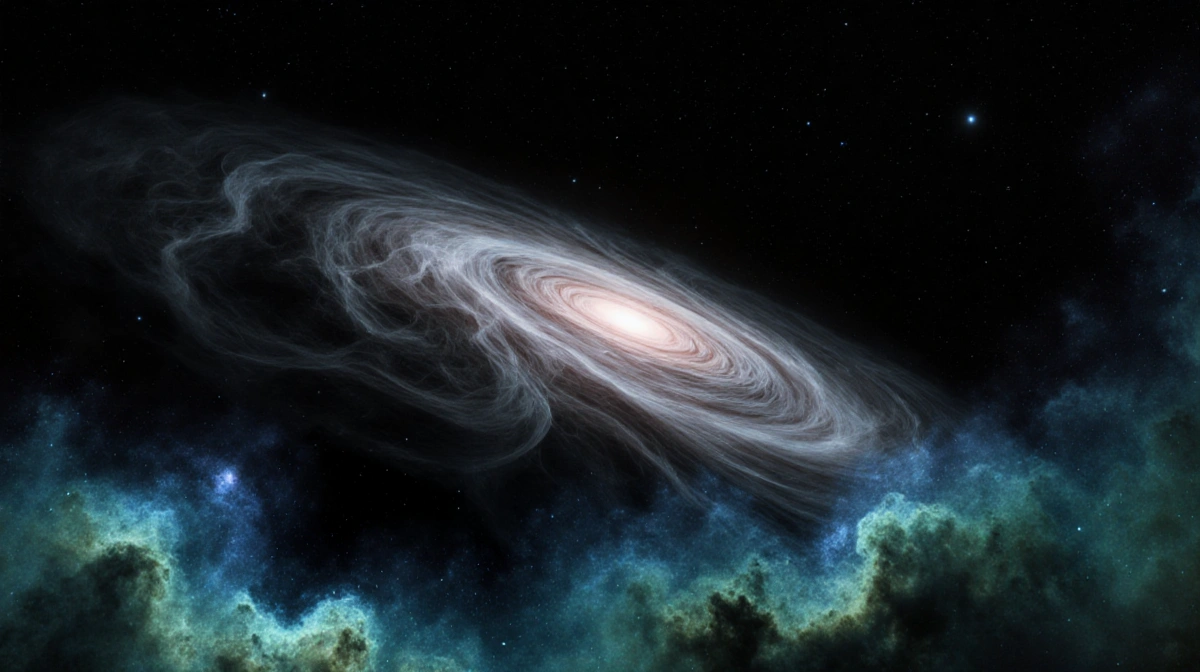
A massive, chaotic disk was unveiled by NASA’s Hubble Space Telescope. The 1,000-light-year-distant disk, nicknamed “Dracula’s Chivito,” is nearly 400 billion miles wide and was first identified in 2016. Hubble’s visible-light images reveal wisps of material extending far above and below the disk, concentrated on one side.
The disk’s appearance resembles a sandwich when viewed edge-on: a dark central lane flanked by white layers of gas and dust. The nickname honors two researchers-one from Transylvania and one from Uruguay-reflecting the dish’s cultural roots.
Observations and Insights
Kristina Monsch, lead author and postdoc at the Center for Astrophysics, said:
> “The level of detail we’re seeing is rare in protoplanetary disk imaging, and these new Hubble images show that planet nurseries can be much more active and chaotic than we expected.”

Joshua Bennett Lovell, co-author, added:
> “We were stunned to see how asymmetric this disk is.”
Key observations:
- Disk is nearly edge-on, with wispy upper layers and asymmetric features.
- Extended filaments appear only on one side, hinting at dynamic processes.
- Disk contains 10-30× the mass of Jupiter.
Potential for Planet Formation
The disk may surround a single massive, hot star or a binary pair. With 10-30× Jupiter’s mass, it could host multiple gas-giant planets. Monsch noted:
> “In theory, [Dracula’s Chivito] could host a vast planetary system. While planet formation may differ in such massive environments, the underlying processes are likely similar.”
Future Observations
Hubble and NASA’s James Webb Space Telescope will continue to monitor the disk to uncover the forces shaping its unusual structure.
Key Takeaways
- Disk is ~40× wider than our solar system.
- Asymmetric filaments suggest complex, dynamic processes.
- Mass allows for formation of multiple gas-giant planets.
These images provide a rare glimpse into a chaotic planet-forming nursery, reshaping our understanding of how planets emerge in massive disks.