
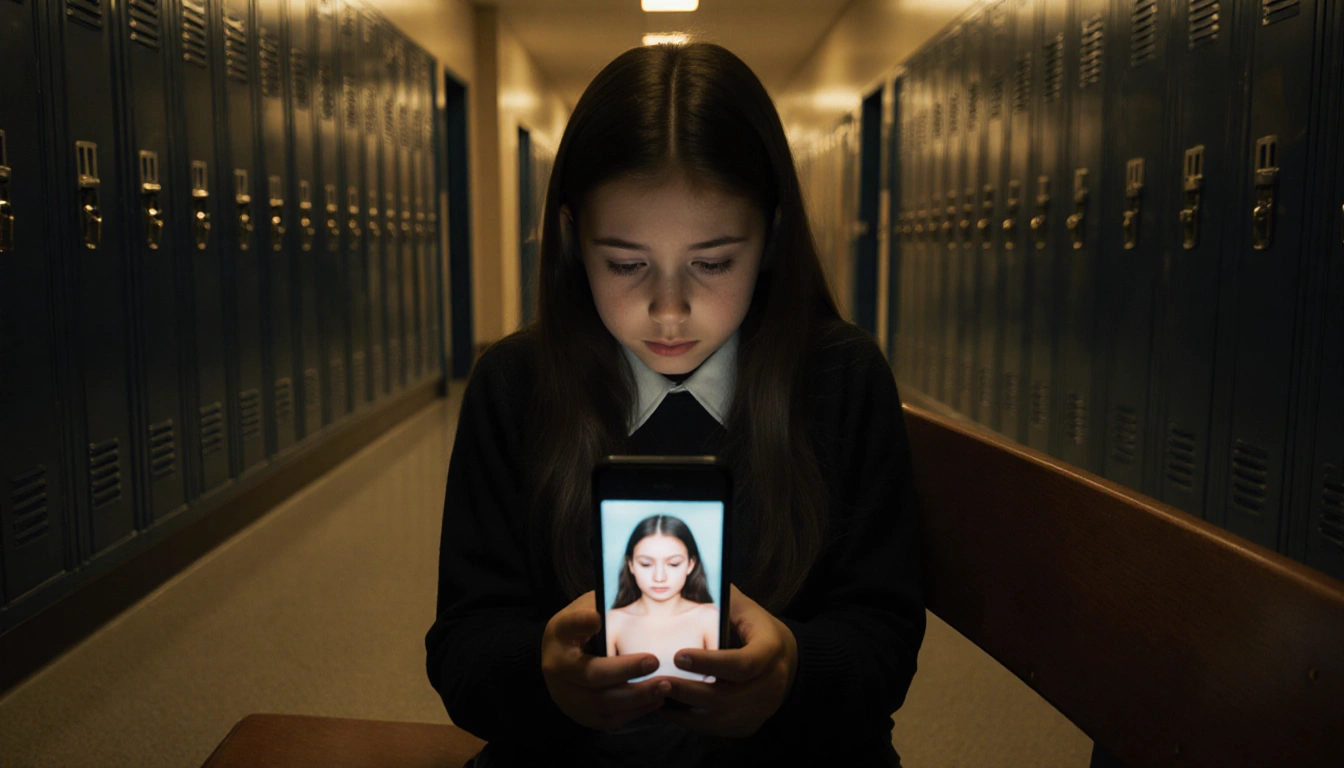

The story began with a wave of AI-generated nude images that surfaced on Snapchat, featuring a 13-year-old girl and her friends. The photos, created by deep-fake technology, spread rapidly through a Louisiana middle school and ignited a chain of events that culminated in the girl’s expulsion and the arrest of two boys.
The Images and the Rumors
The 13-year-old, who is not named because she is a minor, first learned of the images when she and two friends marched to the guidance counselor at about 7 a.m. on Aug. 26. She was seeking moral support, unaware that the photos also depicted her. Testimony at her school disciplinary hearing revealed that the images were circulating on Snapchat, an app that deletes messages seconds after they’re viewed, making recovery difficult.
The district and sheriff’s office later confirmed that the images were AI-generated and included eight female middle school students and two adults. The girl’s father, Joseph Daniels, described them as “Full nudes with her face put on them.” He has spoken publicly with multiple news outlets to draw attention to how the case was handled.
Despite the school’s efforts, the images continued to circulate. When the girl stepped onto the Sixth Ward Middle School bus at the end of the day, a classmate was showing one of the photos to a friend. The girl, who was already angry, slapped the boy and later punched and stomped on him. Two classmates joined her, and the fight was captured on video, which was posted to Facebook.
School Investigation and Legal Response
The principal, Danielle Coriell, said the investigation was “cold” because no student took responsibility. She noted that the deputy assigned to the school searched social media for the images but was unsuccessful. “I was led to believe that this was just hearsay and rumors,” the father recalled.
At the disciplinary hearing, the girl’s attorney asked why the sheriff’s deputy had not checked the phone of the boy the girls accused and why he was allowed on the same bus as the girl. Coriell responded that “Kids lie a lot,” adding that in her 17 years as a principal, she has seen students exaggerate incidents.
Three weeks after the fight, the sheriff’s department charged one boy with 10 counts of unlawful dissemination of AI-created images under a new Louisiana state law. A second boy was charged in December with identical charges. Neither boy was identified by authorities because of their ages. The girl faced no charges because of the “totality of the circumstances.”
The district said it followed all protocols for reporting misconduct. Superintendent Jarod Martin stated in a statement that the school followed its reporting procedures and that the case had a “one-sided story” that fails to illustrate its “totality and complex nature.”
The Victim’s Journey
The girl was expelled for 89 school days-almost a full semester-and sent to an alternative school. She had no prior disciplinary problems. She said at her hearing, “I went the whole day with getting bullied and getting made fun of about my body.” The school’s decision to expel her was met with outrage on social media, which the district and sheriff’s office described as “Overwhelming social media sentiment was one of outrage and a demand that the students involved in the fight be held accountable.”
The expulsion had a profound effect on the girl’s mental health. Her father reported that after she was sent to the alternative school, she started skipping meals and stopped completing her online work. He said she was left behind, and she eventually received therapy for depression and anxiety. He added, “She just felt like she was victimized multiple times – by the pictures and by the school not believing her and by them putting her on a bus and then expelling her for her actions.”
Her attorneys appealed to the school board. After a seven-week hearing, the board allowed her to return to campus on Nov. 7, but she remains on probation until Jan. 29. She will miss all dances, sports, and extracurricular activities, including basketball tryouts. Her father called the situation “heartbreaking” and said, “I think they ruined that.”
Broader Implications and Expert Commentary
The incident highlights the “nightmarish potential of AI deepfakes,” said Sergio Alexander, a research associate at Texas Christian University focused on emerging technology. He added, “When we ignore the digital harm, the only moment that becomes visible is when the victim finally breaks.”
Sameer Hinduja, co-director of the Cyberbullying Research Center and professor of criminology at Florida Atlantic University, remarked that most schools are “just kind of burying their heads in the sand, hoping that this isn’t happening.” He noted that the Lafourche Parish School District had only just begun developing policies on artificial intelligence, and its school-level AI guidance mainly addressed academics. The district’s training on cyberbullying had not been updated to reflect the threat of AI-generated sexually explicit images, and its curriculum was from 2018.
The superintendent countered that “Sometimes in life we can be both victims and perpetrators.” His comments were part of the debate over how the school handled the situation and whether the punishment fit the crime.
Key Takeaways
- AI-generated nude images of a 13-year-old and classmates circulated on Snapchat, leading to a school investigation and the expulsion of the victim.
- Two boys were charged with unlawful dissemination of AI images, while the girl faced no criminal charges.
- The school’s response included expulsion, an alternative school placement, and a probationary return, sparking debate over cyberbullying policies and AI regulation.
The case underscores the urgent need for schools to update cyberbullying training and AI policies to protect students from digital harm.