
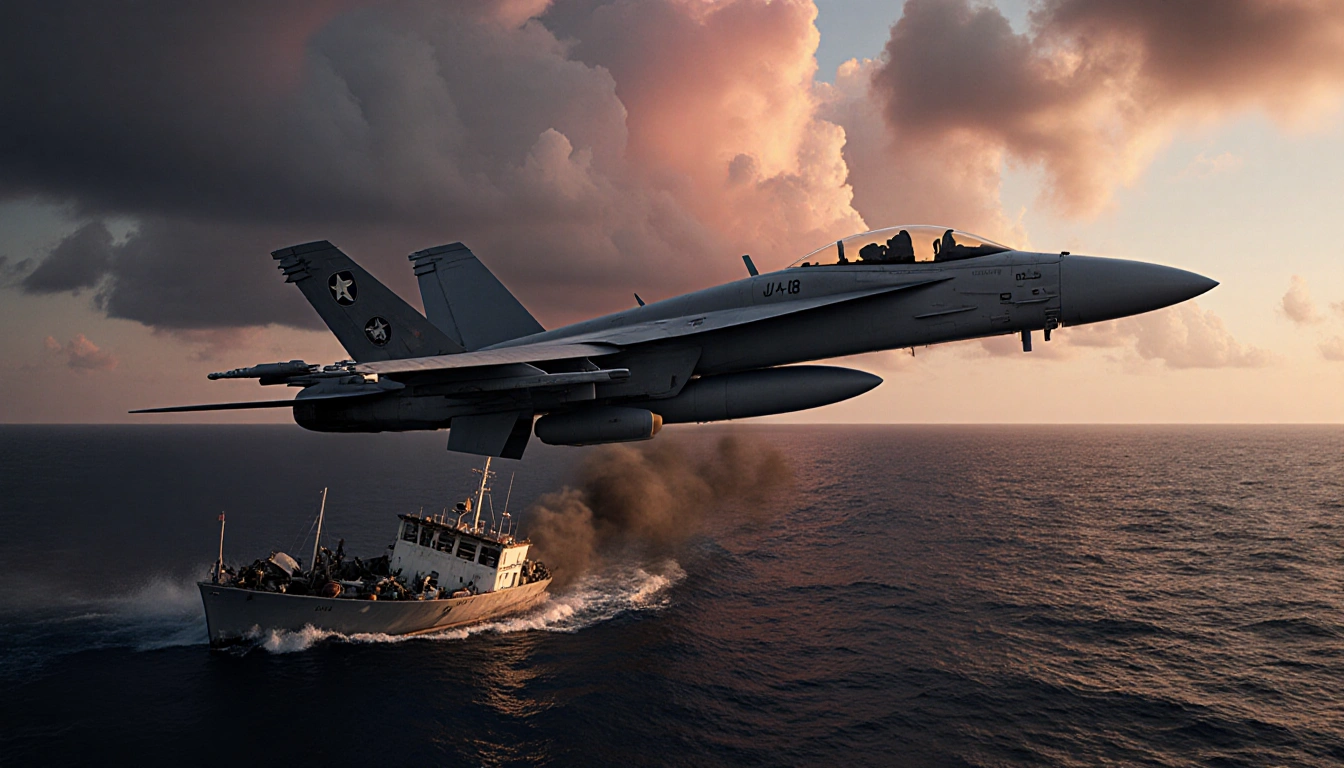

A U.S. strike on an alleged Venezuelan drug vessel in the eastern Pacific on Dec 22, 2025 coincided with President Donald Trump issuing stern warnings to the leaders of Venezuela and Colombia.
The operation, carried out at the direction of Defense Secretary Pete Hegseth, resulted in the death of one individual identified as a narco-terrorist.
Trump’s remarks, delivered to reporters the same day, underscored the United States’ aggressive stance against drug trafficking in the region.
The event highlights the intersection of kinetic military action and high-level diplomatic messaging.
The Dec 22 Strike
The U.S. military announced Monday night that the lethal strike had targeted a low-profile vessel suspected of transporting narcotics.
According to the announcement, the operation was executed under the explicit direction of Defense Secretary Pete Hegseth and was aimed at a vessel “transiting along known narco-trafficking routes.”
The strike reportedly resulted in the death of one individual identified by the U.S. as a narco-terrorist.
This action represents a continuation of the U.S. strategy to disrupt drug shipments in international waters.
Vessel and Operation Details
Intelligence confirmed that the vessel was low-profile and operated by Designated Terrorist Organizations.
The vessel was reported to be transiting along known narco-trafficking routes in international waters, making it a target under U.S. anti-drug enforcement policy.
The classification of the vessel as operated by Designated Terrorist Organizations underscores the U.S. government’s designation of the group as a threat to national security.
The strike aimed to prevent the transport of illicit drugs toward the United States.
Southern Command’s Public Statement
U.S. Southern Command posted on X that on Dec. 22, at the direction of @SecWar Pete Hegseth, Joint Task Force Southern Spear conducted a lethal kinetic strike on a low-profile vessel operated by Designated Terrorist Organizations in international waters.
The tweet, which included a photo link, was posted on December 23, 2025.
Southern Command’s statement emphasized that the vessel was transiting known narco-trafficking routes and that the operation was a direct response to intelligence indicating drug trafficking activity.
The post also mentioned that the strike was part of a broader anti-drug campaign aimed at intercepting vessels before they reach U.S. ports.
The post served to publicly confirm the U.S. military’s engagement in the region.
Pentagon Assessment
The Pentagon has repeatedly stated that targeted vessels are carrying narcotics to the United States.
It also highlighted the strategic importance of disrupting drug trafficking routes to prevent illicit substances from reaching domestic markets.
The statement reflects the U.S. defense policy of using kinetic force to counter narcotics smuggling operations.
The Pentagon’s emphasis on the threat posed by these vessels underscores the broader objective of safeguarding national security and public health.
Scale of the Campaign
Since September, the United States has carried out more than two dozen strikes against alleged drug boats, resulting in the deaths of over 100 people in the Pacific and Caribbean, according to the Pentagon.
These operations target vessels believed to transport cocaine and other narcotics to U.S. shores.
The cumulative impact of these strikes is intended to reduce the volume of drugs entering the United States and to deter future smuggling attempts.
The Pentagon’s report emphasizes the ongoing nature of the campaign and its significance in national security.
Trump’s Warning to Maduro
Speaking to reporters Monday, Trump said, “He could do whatever he wants, it’s alright, whatever he wants to do,” adding that if Maduro plays tough it would be the last time he could play tough.
When asked if the goal was to force Maduro from power, Trump replied, “That’s up to him what he wants to do. I think it would be smart for him to do that.”
Trump’s remarks were delivered in a tone that suggested a warning rather than a direct threat, while also implying that the United States would act decisively against Maduro’s regime if it continued to defy U.S. policy.
Trump’s comments were framed as part of a broader strategy to pressure Maduro into aligning with U.S. policy.
Trump’s Comment on Colombia
Trump also directed his warning to Colombian President Gustavo Petro, calling him a ‘very bad, very bad guy’ who must watch his actions.
He added, “We love the Colombian people. I love the Colombian people. They’re great people, energetic, smart, great. But their new leader is a troublemaker, and he better watch it.”
The president’s comments reflected a clear stance against Petro’s administration, which has publicly opposed U.S. anti-drug strikes.
Trump’s remarks also highlighted a disagreement over Colombia’s approach to anti-drug operations.
Timing of the Events
The strike and the presidential remarks occurred on the same day, underscoring a coordinated U.S. effort to address drug trafficking while signaling diplomatic pressure on regional leaders.
The simultaneous timing suggests that the U.S. military action was intended to reinforce the political message delivered by President Trump.
This alignment of kinetic force and public statements demonstrates the United States’ strategy of combining military operations with diplomatic messaging to influence regional politics.
Political Ramifications
The U.S. military’s aggressive stance and Trump’s public statements could influence diplomatic relations in the Western Hemisphere.
Maduro’s regime may face increased scrutiny, while Petro’s administration might reassess its policy toward U.S. anti-drug operations.
The potential shift in diplomatic dynamics could affect future cooperation on security and trade issues.
These developments highlight the broader impact of U.S. anti-drug policy on regional governance and international relations.
Broader Anti-Narcotics Context
These actions are part of a larger U.S. strategy to curb the flow of narcotics from Latin America to the United States.
By targeting vessels in international waters, the U.S. seeks to disrupt supply chains before drugs reach domestic markets.
The strategy also aims to deter future smuggling attempts by demonstrating the U.S. military’s willingness to use force against drug traffickers.
The U.S. also works with regional partners to share intelligence and coordinate interdiction efforts.
This approach reflects a broader effort to protect public health and national security.
Key Takeaways
- Dec 22 strike killed one narco-terrorist on a low-profile vessel.
- Trump warned Maduro and Petro about U.S. stance on drug trafficking.
- U.S. has conducted over 24 strikes, killing more than 100 people since September.
Final Thoughts
The combination of kinetic action and political rhetoric illustrates the U.S. commitment to combatting drug trafficking while engaging with regional governments.
Observers will monitor how these developments shape future U.S. policy and regional dynamics.
The event underscores the United States’ readiness to use force in support of its anti-drug objectives.