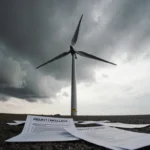

On Monday, the Trump administration announced it would pause leases for five major offshore wind projects along the U.S. East Coast, citing national security risks identified by the Pentagon.
The pause, effective immediately, comes after a federal judge declared the president’s earlier executive order blocking wind projects unlawful.
Interior Secretary Doug Burgum said the action would allow the Interior Department to work with the Defense Department and other agencies to assess how to mitigate any security risks posed by the projects.
The statement did not detail the specific risks, leaving many in the renewable-energy community to speculate about the underlying concerns.
## Pause of Leases for Five Projects
The five projects affected by the pause include Vineyard Wind in Massachusetts, Revolution Wind in Rhode Island and Connecticut, Coastal Virginia Offshore Wind, and the two New York ventures Sunrise Wind and Empire Wind.
All five are under construction and had received leases on federal waters.
The Interior Department said the pause would give the agency time to evaluate potential vulnerabilities before moving forward.
The projects are among the largest offshore wind developments in the United States, with combined capacity in the range of several gigawatts.
## Legal Context: Judge’s Decision
The pause follows a ruling by U.S. District Judge Patti Saris of the District of Massachusetts, who vacated President Donald Trump’s January 20 executive order that had blocked leasing and permitting of wind energy projects on federal lands and waters.
Judge Saris found the order “arbitrary and capricious” and in violation of U.S. law.
The decision was issued after a coalition of 17 states and Washington, D.C., led by New York Attorney General Letitia James, challenged the order.
The court’s ruling effectively restored the ability of developers to seek permits for offshore wind projects.
## National Security Rationale
Interior Secretary Burgum emphasized that the United States’ primary responsibility is to protect its people.
He said the action addressed emerging national security risks, including the rapid evolution of adversary technologies and the vulnerabilities created by large-scale offshore wind projects near population centers on the East Coast.
The Interior Department cited unclassified reports indicating that massive turbine blades and highly reflective towers can create radar interference, known as “clutter.”
This clutter can obscure legitimate moving targets and generate false targets near wind projects, according to the department.
## Defense Review
National security expert Kirk Lippold, former commander of the USS Cole, noted that the projects had gone through years of review by state and federal agencies, including the Coast Guard, the Naval Undersea Warfare Center, and the Air Force.
He argued that the permitting process had involved the Department of Defense at every stage and that the projects would ultimately benefit national security by diversifying the country’s energy supply.
Lippold said the projects were awarded permits following thorough reviews, suggesting the risks were manageable.
## Industry Reactions – Overview
Wind proponents condemned the pause as another blow to clean energy.
Ted Kelly of the Environmental Defense Fund called the administration’s actions illegal and said offshore wind provides some of the most affordable, reliable electric power to the grid.
He said the administration had “recklessly obstructed the build-out of clean, affordable power for millions of Americans” and that the move “should not be kneecapping America’s largest source of renewable power.”
## Industry Reactions – Conservation Law Foundation
The Conservation Law Foundation, a Boston-based environmental group, described the pause as “a desperate rerun of the Trump administration’s failed attempt to kill offshore wind.”
Senior vice president for law and policy Kate Sinding Daly said the move “tramples on the rule of law, threatens jobs and deliberately sabotages a critical industry that strengthens – not weakens – America’s energy security.”
## Industry Reactions – Coal Plant Commentary
Both groups highlighted that the administration’s actions come while it continues to support aging, expensive coal plants that “barely work and pollute our air,” according to Kelly.
They argued that the pause undermines the nation’s energy security and the economic benefits of clean energy development.
## Broader Context
The pause is the latest step the administration has taken to hobble offshore wind in its push against renewable energy sources.
It follows a pattern of actions that have targeted wind projects across the country, reflecting the administration’s preference for fossil fuels as the primary source of electricity.
The decision to pause leases, however, signals a shift in the administration’s stance on national-security concerns associated with offshore wind infrastructure.
## Process and Timing
The Interior Department will collaborate with the Defense Department and other agencies to assess how best to mitigate the identified security risks.
The pause is effective immediately, meaning all construction and leasing activities on the affected projects have been halted pending further review.
The administration’s statement indicates that the pause is temporary and that the Interior Department will seek a resolution that balances energy development with security considerations.
## Implications for Developers
For developers, the pause introduces uncertainty and potential delays in project timelines and financing.
The five projects were already in advanced stages of construction, and the halt could impact investors, contractors, and local communities that rely on the projects for jobs and economic growth.
The pause also raises questions about how future offshore wind projects will be evaluated for security risks before leases are granted.
## Closing Summary
With the pause in effect, the Interior Department’s next steps will determine whether the projects can resume or face further scrutiny.
The move underscores the complex interplay between renewable-energy development and national-security considerations on the U.S. East Coast.
While the administration cites security risks, critics argue that the pause hampers progress toward clean, affordable power and threatens the country’s energy future.