
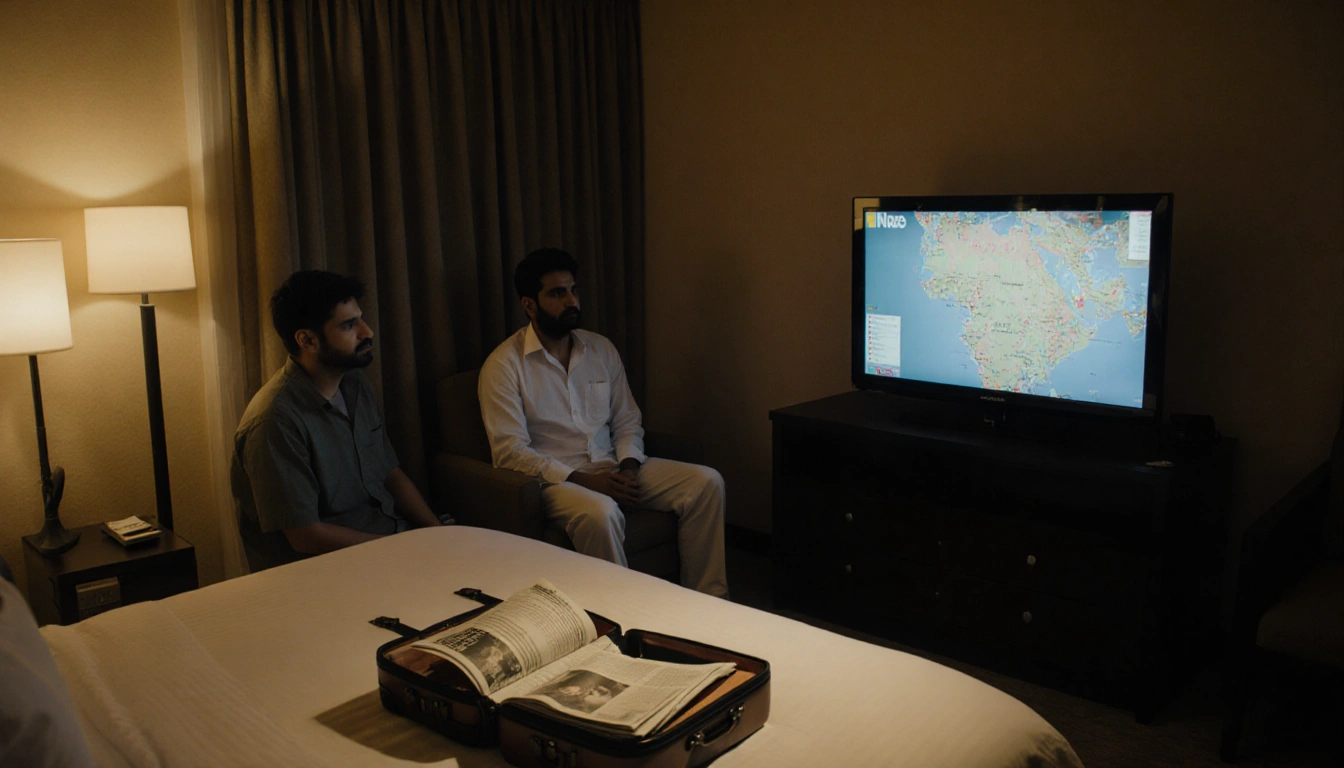
A father and son arrived in the southern Philippines on Nov. 1 after flying from Australia, and they remained in Davao for almost a month before returning to Sydney, where they are accused of killing 15 people at a beachside Hanukkah event. The pair—24‑year‑old Naveed Akram and his 50‑year‑old father Sajid Akram—checked into the low‑key GV Hotel, a modest budget establishment, and largely stayed in their room, according to hotel staff.
The flight from Sydney to the Philippines was confirmed by immigration officials, who listed Davao as the final destination. Australian law enforcement identified the suspects by name, noting that Sajid Akram was shot dead at the scene of the Sydney attack on Sunday, while Naveed Akram was charged with 59 offenses—including terrorism and 15 counts of murder—after waking from a coma.
Upon arrival, the duo booked a one‑week stay at the GV Hotel and later extended it. Georgio, a front‑desk staffer who only identified himself by that name, told NBC News that the men were “normal guests.” He added that they walked outside to buy food and returned to sleep, describing them as “not suspicious.”
Night‑desk manager Angelica Ytang, 20, told the AFP news agency that the pair left the hotel in the morning but “didn’t stay out long … the longest we observed was about one hour.” Ytang emphasized that the men never discussed the purpose of their stay and were “not approachable like other foreigners.”
Local police visited the hotel on Wednesday and Thursday, requesting surveillance footage. The hotel staff confirmed that the men were only in the room most of the day, and that they did not interact with other guests or staff beyond routine exchanges.
Dashcam footage from a nearby vehicle captured a scene in which a couple—killed in the Sydney attack—attempted to stop one of the gunmen. The footage was shared with investigators as part of the broader inquiry into the suspects’ activities in the Philippines.
No evidence has emerged that the father and son received military‑style training during their stay in Davao. Philippine officials have vehemently rejected suggestions that the country is a hot bed for terrorism, stating that a mere visit does not support allegations of training and that the duration of their stay would not have allowed for any meaningful or structured training.
National security adviser Eduardo Año said Wednesday that “a mere visit does not support allegations of terrorist training and the duration of their stay would not have allowed for any meaningful or structured training.” He added that remnants of terrorist organizations in the area are “fragmented, deprived of leadership and operationally degraded,” and that there have been no recorded terrorist training activities.
The Philippines has a long history of Islamist insurgency, particularly in Mindanao, the southern island that was colonized by Spain, the United States, and Filipino Christian settlers. The region’s Muslim majority population has been reduced to a minority, and in recent decades it has suffered violence that killed about 150,000 people.
During the late 1980s and 1990s, Mindanao became a stronghold for radical Islamist groups that pledged allegiance to Al Qaeda. After Al Qaeda was stamped out, many remaining fighters turned their allegiance to ISIS. Rommel Banlaoi, chairman of the Philippine Institute for Peace, Violence and Terrorism Research, said the Philippines “became the main training hub of Southeast Asian fighters during the Al Qaeda days, and became the epicenter of East Asia Wilaya during the ISIS days.”
A 2014 peace deal granted broader Muslim autonomy and brought many rebel leaders into the fold of the country’s efforts against ISIS. However, some groups splintered off, including the ISIS‑affiliated Abu Sayyaf, which the U.S. blacklisted for mass kidnappings, executions and deadly bombings.
In 2017, these groups captured Marawi, the country’s biggest Muslim‑majority city, but many fighters were killed in the month‑long siege, and they have been further weakened since.
Experts say the remnants of these terrorist organizations are now very low in strength. Greg Barton, chair of global Islamic politics at Deakin University, noted that “the groups are not very active now.” Rohan Gunaratna, a professor of security studies at Nanyang Technology University, added that remaining militants “perhaps only a few dozen” are still active in the southernmost part of the island, about three hours’ drive from Davao.
Gunaratna described Davao as “one of the main points of entry” to the areas where militants are still present, while Banlaoi echoed that the groups are “fragmented, deprived of leadership and operationally degraded.”
Australian authorities have said it appears the father and son acted alone, but the presence of two ISIS flags in the son’s car showed they “clearly wanted to be seen in acting in the name” of ISIS, Barton said. This suggests they could have been meeting people they respected as Islamic State militant group leaders, even if they did not receive formal training in the Philippines.
The investigation into the suspects’ stay in Davao is now focused on what they did at the hotel, who they may have met, and how that period may have influenced the planning of the Sydney massacre. Philippine officials are continuing to gather evidence, while Australian law enforcement remains engaged in the broader case.
The Islamic State militant group that inspired the suspects has praised them but has not officially claimed the attack, referring to it in an official publication as “Sydney’s pride.” The pair’s flight, hotel stay, and subsequent return to Sydney have become central to the inquiry, as authorities seek to understand whether the Philippines played any role in the planning or execution of the tragic event.
In the days following the attack, authorities in both countries have emphasized that the suspects acted alone, but the investigation remains open to uncovering any links that may have existed during their nearly month‑long stay in Davao.
Key Takeaways
- The father and son stayed at GV Hotel in Davao for almost a month before the Sydney attack.
- Philippine officials deny any evidence of training or extremist activity during their stay.
- Experts say the remnants of ISIS‑affiliated groups in Mindanao are fragmented and weak.
The investigation continues as authorities in Australia and the Philippines work together to piece together the suspects’ movements and connections during their time in Davao, seeking to fully understand the path that led to the tragic Sydney massacre.