


At a Glance
- The American Academy of Pediatrics (AAP) released its 2026 childhood and adolescent immunization schedule, maintaining 18 routine vaccines.
- The Centers for Disease Control and Prevention (CDC) announced a new schedule that eliminates RSV, hepatitis A, hepatitis B, rotavirus, influenza, and meningococcal for all children.
- The AAP’s schedule is endorsed by 12 major medical organizations.
Why it matters: Parents and health providers must know which vaccines are recommended by the leading pediatric authority versus the federal agency.
—
The American Academy of Pediatrics issued its updated childhood and adolescent immunization schedule for 2026, largely maintaining previous recommendations that differ significantly from the controversial changes recently made by the Centers for Disease Control and Prevention.
—
AAP 2026 Vaccine Schedule
The AAP’s 2026 schedule continues to recommend routine immunizations for 18 different diseases, including those removed from the CDC’s schedule. The list of recommended vaccines remains largely unchanged from previous years, covering measles, mumps, rubella, polio, pertussis, tetanus, diphtheria, Haemophilus influenzae type B (Hib), pneumococcal disease, HPV, chickenpox, and the six vaccines that the CDC has removed.
> “At this time, the AAP no longer endorses the recommended childhood and adolescent immunization schedule from the Centers for Disease Control and Prevention,” said Dr. Sean O’Leary, chair of the AAP’s Committee on Infectious Diseases, in a policy statement published in the journal Pediatrics.
The AAP’s statement emphasizes that its schedule is evidence-based and designed to protect children against preventable diseases.
—
CDC’s Overhaul of the Childhood Vaccine Schedule
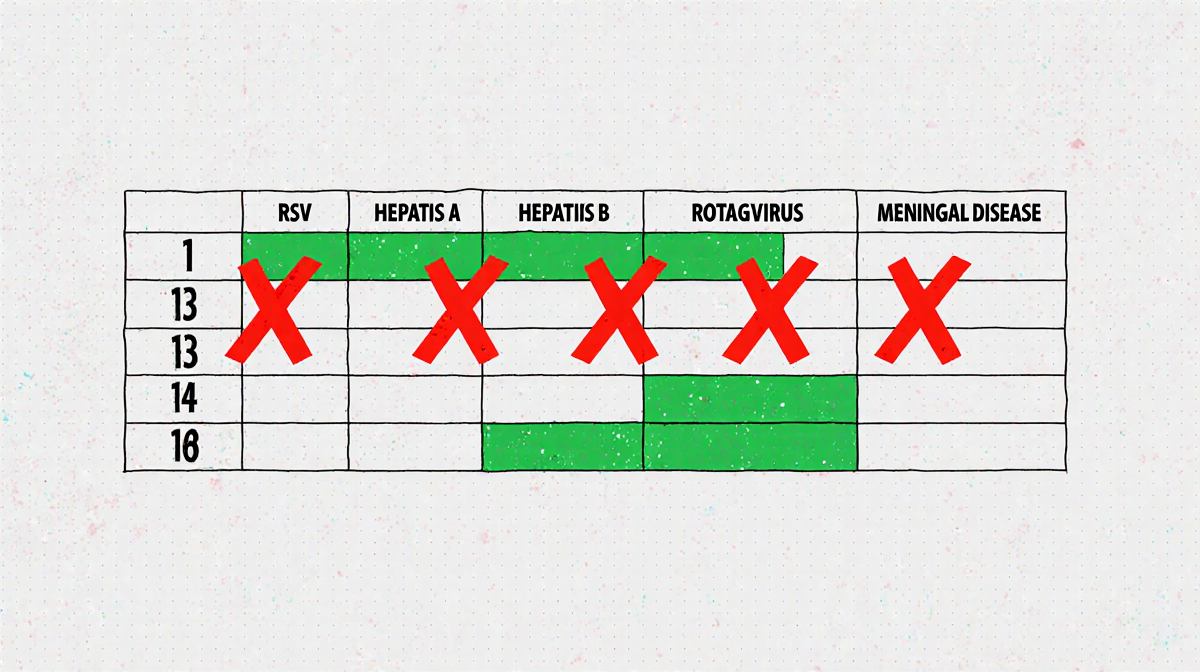
Earlier this month, the CDC announced an unprecedented overhaul of the childhood vaccine schedule that recommends fewer shots to all children. Among the vaccines no longer recommended by the CDC are RSV, hepatitis A, hepatitis B, rotavirus, influenza, and meningococcal disease.
The federal government now only recommends protection against diseases like RSV, hepatitis A and B, and meningococcal for certain high-risk populations. Additionally, vaccines like the flu shot and COVID-19 should be based on individual doctor advice in what the CDC is calling “shared clinical decision-making.”
The U.S. Department of Health and Human Services said the overhaul was in response to a request from President Donald Trump in December. Trump asked the agency to review how peer nations approach vaccine recommendations and consider revising U.S. guidance accordingly.
HHS said its comparison to 20 peer nations found that the U.S. was an “outlier” in both the number of vaccinations and the number of doses it recommended to all children. Officials with the agency framed the change as a way to increase public trust by recommending only the most important vaccinations for children to receive.
—
Endorsements and Reactions
The academy’s recommendations are endorsed by 12 major medical and health care organizations, including the American Academy of Family Physicians, the American College of Obstetrics and Gynecology, and the American Medical Association.
The CDC did not immediately respond to a request for comment. The AAP’s stance signals a clear divide between the two bodies on how many vaccines children should receive.
—
Impact on Insurance and School Requirements
The childhood vaccine schedule is a set of recommendations on the timing of vaccinations. It’s not a mandate, but is used to guide what vaccines are covered by insurance and are needed to attend daycare and public schools. Health insurers generally find vaccination a good deal, as shots are cheaper than hospitalizations, and many had previously said they’d planned to cover what was recommended last year through 2026.
States determine which vaccines are required for school attendance and have historically relied on the CDC schedule, though some states have begun creating their own alliances to counter the Trump administration’s guidance on vaccines.
—
Expert Insight
Dr. Diego Hijano, a pediatric infectious disease expert from St. Jude Children’s Research Hospital, is often consulted for questions about how the MMR vaccine can protect kids from measles. While the AAP’s schedule continues to recommend MMR, the CDC’s new guidance does not alter that recommendation.
—
Key Takeaways
- The AAP’s 2026 schedule maintains 18 routine vaccines, including those the CDC has removed.
- The CDC’s new schedule eliminates RSV, hepatitis A, hepatitis B, rotavirus, influenza, and meningococcal for all children.
- 12 major medical organizations endorse the AAP’s recommendations.
- Insurance coverage and school requirements will likely continue to follow the AAP schedule, though some states may shift.
- Parents should consult their pediatrician to understand which vaccines are recommended for their child.
—
The Associated Press contributed to this report.