
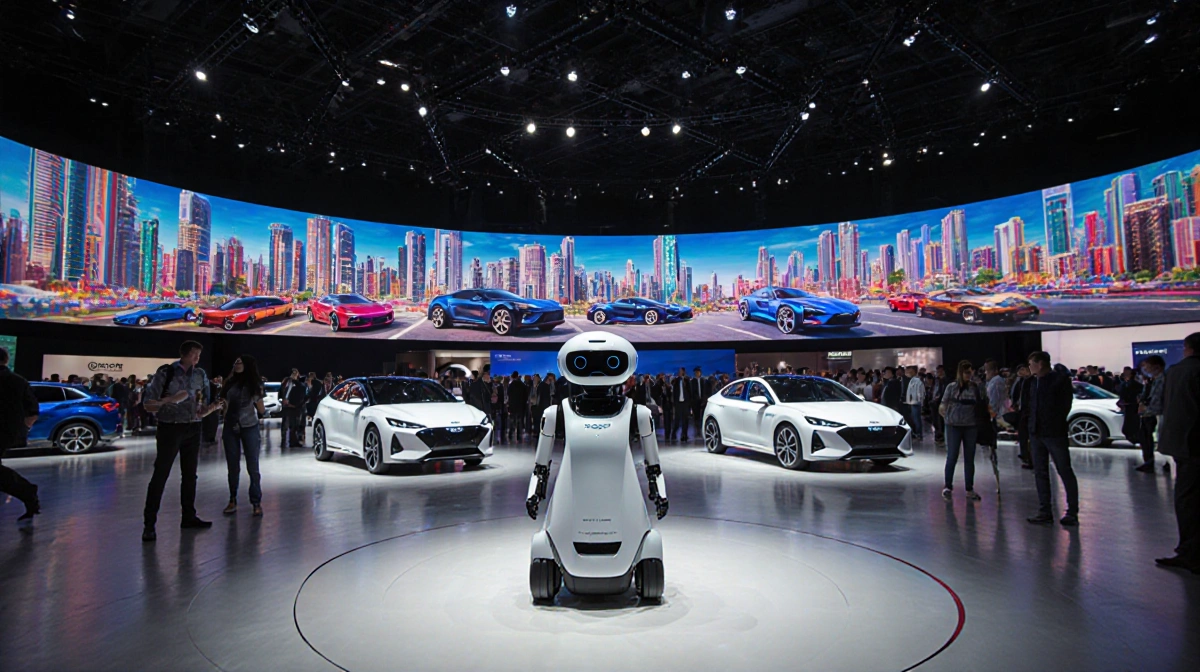
The Consumer Electronics Show floor felt different this January. No Ford, GM or Stellantis booths dominated Central Hall. Instead, autonomous-vehicle startups, Chinese brands and chip makers claimed the space U.S. car companies once owned.
At a Glance
- U.S. automakers skipped CES 2026, ceding floor space to AV and robotics firms
- Hyundai drew crowds with Boston Dynamics humanoids, not cars
- Mobileye paid $900 million for humanoid-robot startup Mentee Robotics
- President Trump urged China and Japan to build U.S. plants, alarming industry lobbyists
- Canada cut its Chinese-EV import tax from 100% to 6.1%
Why it matters: The shift signals Silicon Valley-not Detroit-is now driving the next wave of transportation innovation.
Automakers ghost Vegas
Zoox, Tensor Auto, Tier IV and Waymo filled the void. Each showed hardware or software for driverless fleets. Nvidia CEO Jensen Huang’s phrase “physical AI” appeared on banners and slide decks across the convention center.
The term describes AI models that power real-world machines. Cameras, lidar and motors let robots or robotaxis perceive and act. Exhibits spanned agriculture drones, warehouse bots, wearables and autonomous forklifts.
Hyundai’s robot circus
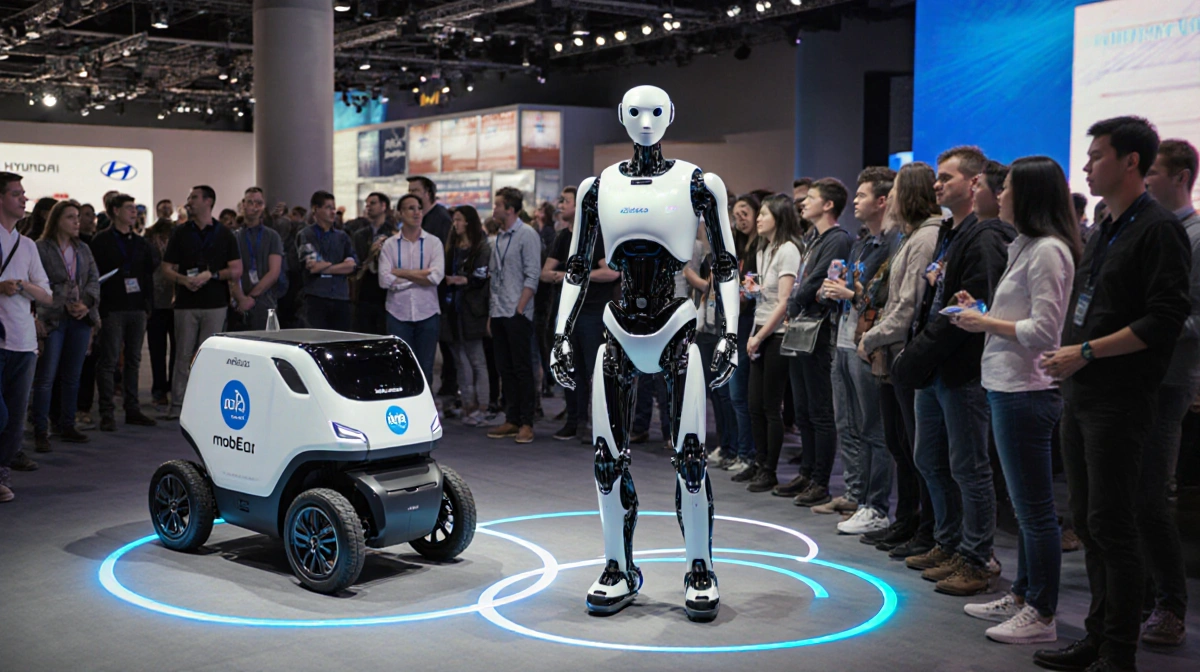
Hyundai’s booth ran a constant queue. Attendees came to see Atlas, the humanoid from Boston Dynamics, and a new four-wheeled platform called MobEd. The Mobile Eccentric Droid enters production this year and can carry small cargo or passengers at low speed.
The automaker’s robotics lab also demoed an autonomous charging arm that tops up electric vehicles without human help. Executives said the goal is to become a “mobility provider” beyond cars.
The hype debate
Mobileye co-founder Amnon Shashua brushed off bubble talk after buying Mentee Robotics for $900 million in December.
“The internet was also a hype, remember in 2000,” he said. “Hype means companies are overvalued for a certain period, then crash. It does not mean the domain is not real. I believe humanoids are real.”
Washington vs. Beijing on wheels
President Trump told the Detroit Economic Club he would welcome Chinese car factories. “If they want to come in and build a plant and hire you and hire your friends and your neighbors, that’s great,” he said.
The Alliance for Automotive Innovation, the main lobbying group, is “freaking out,” a Washington insider told News Of Philadelphia. Current federal rules already block most Chinese-connected vehicles under a 2025 Commerce Department ban on hardware and software tied to China or Russia.
Avery Ash, CEO of SAFE, warned the strategy “would have potentially catastrophic impacts on our automotive industry.” SAFE focuses on securing U.S. energy and supply chains.
Canada opens the door
While Washington talks tariffs, Ottawa slashed its 100% import tax on Chinese EVs to 6.1%, Prime Minister Mark Carney announced. The move could make Canada a back-door route into North America for BYD and other brands.
Deal flow
- Allegiant to buy Sun Country Airlines for roughly $1.5 billion in cash and stock
- Dealerware, an auto-retail software firm, sold to Wavecrest Growth Partners and Radian Capital; terms undisclosed
- Flix acquired majority stake in airport-transfer platform Flibco; SLG retains minority share
- JetZero raised $175 million Series B led by B Capital for its blended-wing aircraft
- Joby Aviation will buy a 700,000-square-foot plant in Dayton, Ohio, to build four air taxis a month by 2027
- Luminar sold its lidar division to Quantum Computing Inc. for $22 million, down from an $11 billion peak valuation in 2021
Data and drones
The FTC finalized an order barring General Motors and OnStar from sharing consumer driving data with credit agencies. GM must also let drivers delete stored information.
Wing, Alphabet’s drone-delivery unit, will serve 150 more Walmart stores this year. The expansion follows pilot programs in Texas and Virginia.
New York eyes robotaxis
Governor Kathy Hochul will propose legislation to legalize driverless for-hire vehicles outside New York City. Details are expected in her executive budget next week. Waymo holds a limited test permit inside the five boroughs but has not launched commercial service.
Tesla switches to subscriptions
Tesla quietly removed the $8,000 one-time purchase option for Full Self-Driving (Supervised). U.S. customers must now subscribe at $99 a month.
Key Takeaways
- CES 2026 proved robotics, not sheet metal, now captures consumer imagination
- Policy splits widen: Canada courts Chinese EVs while U.S. law keeps them out
- Cash is moving to aviation startups and lidar fire-sales as valuations reset
- States like New York may open roads to robotaxis just as Tesla tightens access to its own software